
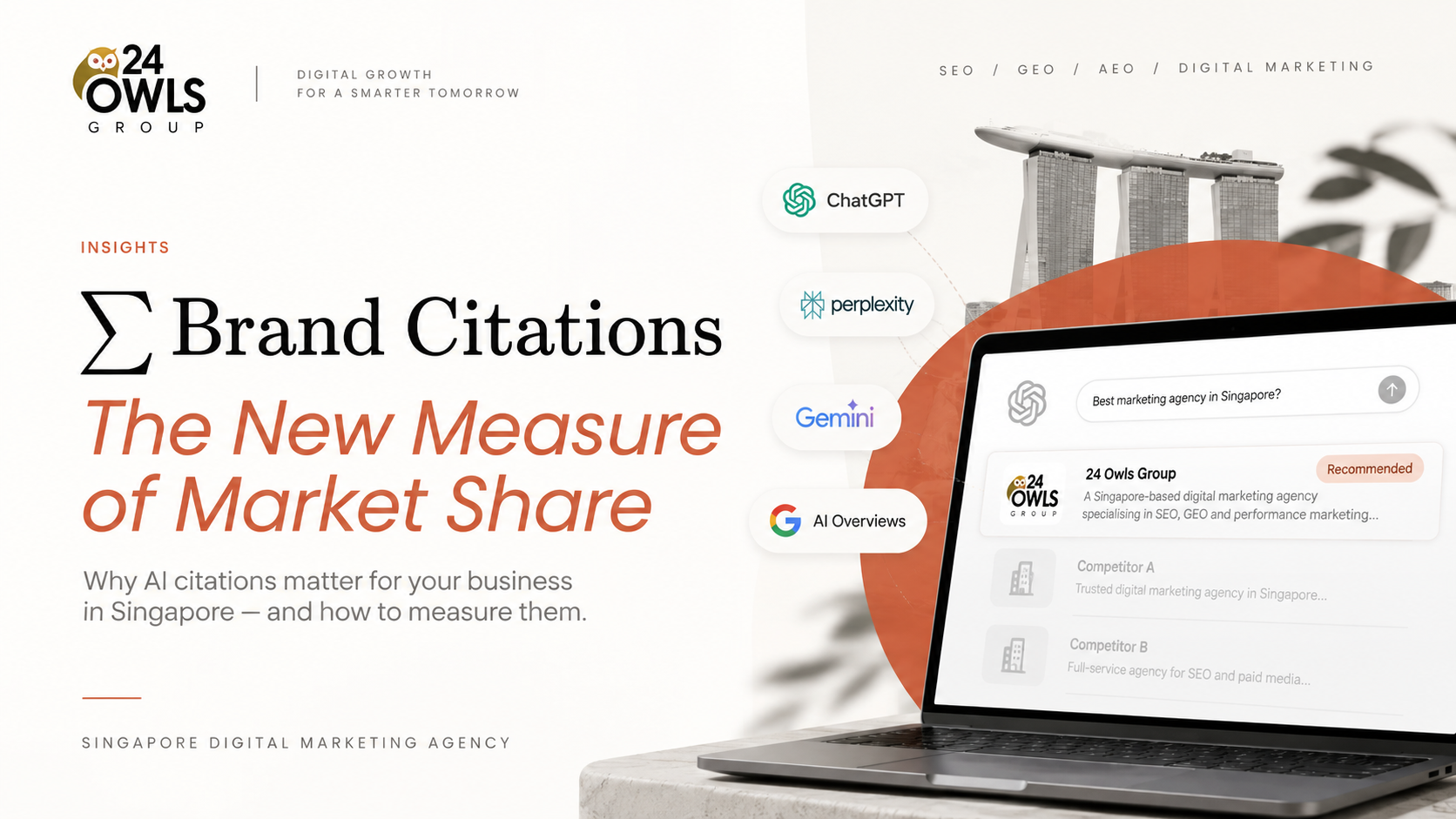
To accurately measure your brand’s Citation Share, you must run an unbiased, three-stage empirical protocol:
- Curate a standardized matrix of 50 to 100 buyer-intent prompts across your sector.
- Execute them through headless, clean-room environments across ChatGPT, Perplexity, Gemini, and Google AI Overviews using local Singapore IP proxies.
- Calculate the proportion of brand recommendations and source citations your domain captures relative to the total citations awarded across your competitor set.
AI Citation Share Formula
Without this disciplined calculation, most marketing leaders in Singapore are flying blind.
In boardroom suites along Marina Bay, aesthetic clinics in Orchard, and boutique interior design firms in Tanjong Pagar, dashboards still display reassuring green charts.
Traditional keyword rankings hold steady, organic impressions look healthy, and classic SEO retainers appear fully justified.
Yet inbound qualified enquiries have begun to soften. High-intent, ready-to-buy clients simply aren't clicking through the way they did eighteen months ago.
The Structural Shift
The reason is structural: your buyers are no longer scrolling through pages of blue links.
They are asking AI search engines to evaluate, compare, and shortlist partners on their behalf.
When an LLM answers, it rarely outputs a directory—it recommends two or three vetted brands, links its authoritative sources, and resolves the decision in a single screen.
If your business is excluded from that synthesis, your classic search rankings are irrelevantly defending empty ground.
Tracking your AI Citation Share is no longer an academic exercise; it is the modern baseline of commercial market share in Singapore.
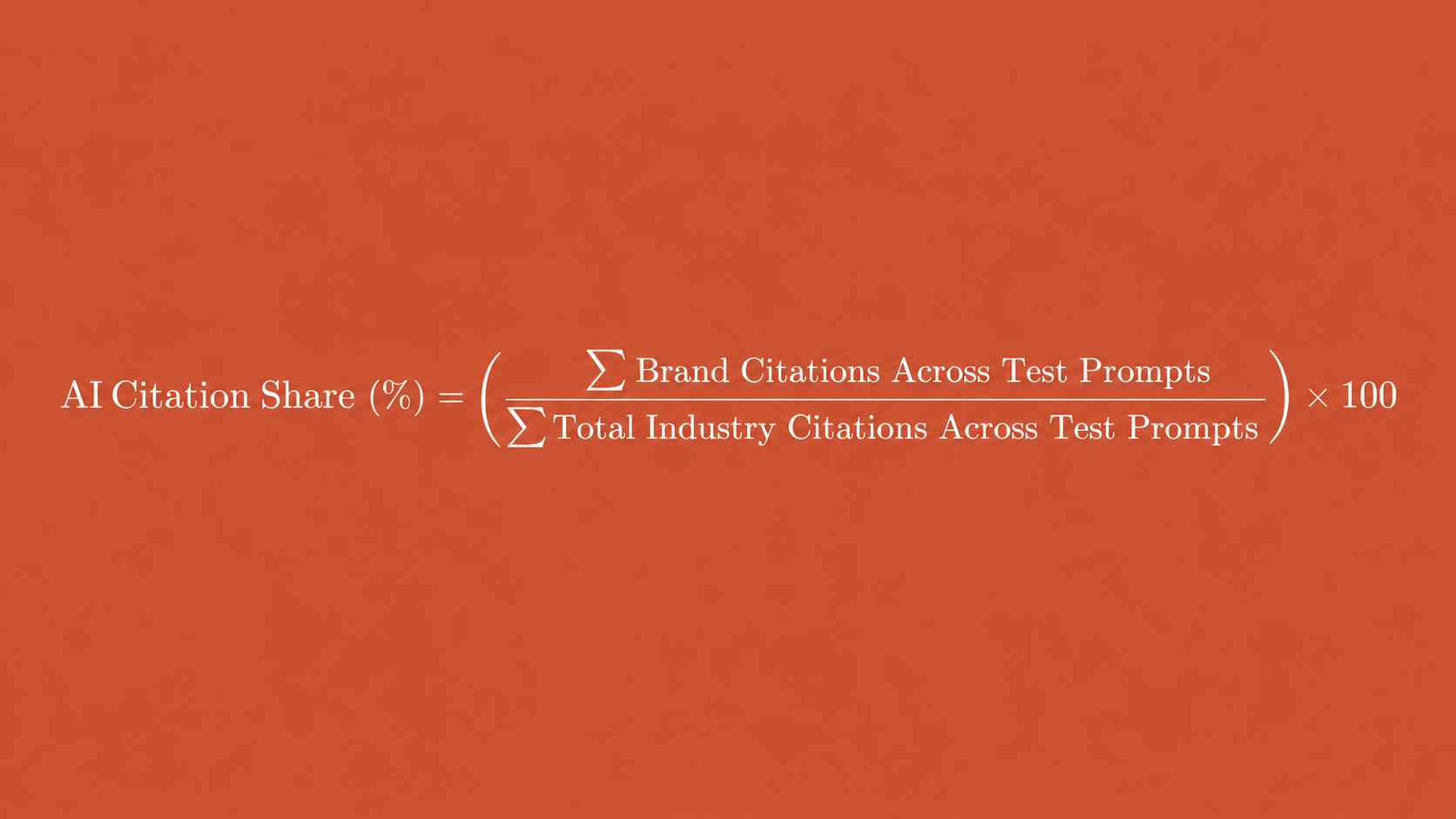
The Core Metric: Mathematical Formula for Brand Citation Share
To measure citation share accurately, enterprise teams must move beyond subjective sentiment and calculate an empirical ratio against direct industry rivals:
Where:
- captures every verified instance where your brand domain, named entity, or specific page URL is cited as a supporting source.
- represents the sum total of all citations awarded to your brand and your direct competitors across that identical prompt cohort.
The Two Tiers of Citation Quality: Footnotes vs Recommendations
Not all citations carry equal commercial weight. An empirical audit separates data into two categories:
- Footnote Citations (Passive Authority): The model lists your URL in the source chips or numbered bibliography, but does not explicitly name your brand in the body copy.
- In-Text Recommendations (Active Endorsement): The model synthesises your brand directly into the primary advice (e.g., "For homeowners seeking transparent pricing and CaseTrust protection, 9Creation is widely shortlisted").
This qualitative distinction forms the backbone of our Generative Engine Optimization (GEO) framework, where the goal is shifting algorithms from passive footnote indexation to active verbal endorsement.
A Worked Example: Calculating Citation Share for 9Creation (Singapore Interior Design)
To see the formula in practice, consider established Singapore interior design firm 9Creation—widely recognised for residential renovations across HDB BTOs, private condominiums, and landed estates in Singapore.
Suppose 9Creation wants to objectively benchmark its generative AI visibility against its five primary direct competitors in the Singapore interior design landscape.
1. The Raw Citation Audit
Across the 200 generated responses, the four AI engines produced a cumulative total of 320 domain and brand citations distributed across the six firms:
| Interior Design Firm | Footnote Citations | In-Text Recommendations | Total Citations () |
|---|---|---|---|
| Competitor A (Legacy Brand) | 58 | 54 | 112 |
| 9Creation (Our Subject Firm) | 36 | 28 | 64 |
| Competitor B | 32 | 24 | 56 |
| Competitor C | 28 | 20 | 48 |
| Competitor D | 14 | 10 | 24 |
| Competitor E | 10 | 6 | 16 |
| Total Industry Citations in Cohort | 178 | 142 | 320 |
2. Applying the Mathematical Calculation
3. Strategic Diagnosis: What the Numbers Reveal
A 20.0% Citation Share indicates that 9Creation commands one out of every five citations generated across high-intent interior design queries in Singapore. However, breaking down the numbers across engine architectures reveals an invaluable competitive diagnostic:
- The Real-Time Engine Advantage: 9Creation captured a robust 34% Citation Share in Perplexity and Google AI Overviews. This strong showing is powered by rich portfolio indexing, active project case studies, and transparent licensing credentials (such as CaseTrust and RCMA affiliations) that real-time search crawlers can parse and cite immediately.
- The Parametric Model Gap: On ChatGPT, 9Creation's Citation Share dropped to 8%. While Competitor A was repeatedly served as a default recommendation due to dense historical mentions across long-standing web forums and legacy media archives, 9Creation was comparatively under-represented in the pre-trained entity corpus.
- The Commercial Implication: Homeowners asking ChatGPT for curated interior design recommendations are being steered toward Competitor A before discovering 9Creation's portfolio.
This quantitative visibility turns abstract speculation into an exact strategic roadmap: 9Creation does not need more generic keyword-stuffed articles; they require focused entity-graph optimization and high-authority contextual co-occurrences to solidify their presence inside pre-trained LLM models.
The Execution Protocol: Setting Up a Clean-Room Testing Rig
To reproduce the precision seen in the 9Creation case study, your measurement environment must be isolated from search bias. Running ad-hoc prompts in regular browser tabs contaminates data through personalized account history, cached cookies, and localized network noise.
An enterprise audit enforces a three-stage testing architecture:
1. Intent Clustering (The Prompt Architecture)
Never test single keywords. Calibrate your prompt matrix into four operational tiers:
- Unbranded Category Discovery: "What criteria should homeowners evaluate before hiring a landed renovation specialist?"
- Comparative Evaluation: "Compare the top three boutique aesthetic clinics in Singapore for non-surgical rejuvenation."
- Credential-Based Commercial Queries: "Which Singapore firms hold verified CaseTrust and RCMA accreditation?"
- Direct Buyer Shortlisting: "Shortlist reputable B2B corporate tax restructuring advisors near Raffles Place."
2. Environmental Isolation (The Headless Rig)
To capture authentic, unmanipulated outputs:
- Execute prompts programmatically via API endpoints or containerized headless browsers with zero stored cookies.
- Route all connections through residential Singapore IP proxy blocks (matching local ISP ranges such as Singtel or StarHub) to ensure the AI applies Singapore-specific localization rules.
- Fix sampling parameters (e.g.,
temperature=0or0.2) to evaluate the model's core deterministic baseline before testing semantic variations.
3. Cross-Platform Normalization
Because real-time retrieval engines (Perplexity, Google AI Overviews) refresh constantly while parametric foundation models (ChatGPT, Claude) rely on training snapshots, outputs must be recorded simultaneously across a 72-hour window. This snapshot approach prevents localized algorithm updates from skewing the monthly benchmark.
Operational Comparison: In-House Ad-Hoc Sampling vs Managed GEO Audit
Marketing directors must balance the administrative effort of tracking against the commercial value of the intelligence:
| Evaluation Dimension | Ad-Hoc Internal Testing | In-House API Engineering | Managed GEO Audit (Twenty Four Owls) |
|---|---|---|---|
| Audit Volume & Breadth | 10–20 sporadic prompts | 50–100 prompts (Periodic) | 500+ Multi-cluster commercial buyer prompts |
| Bias Elimination | Compromised (Browser cache & accounts) | Moderate (Requires proxy configuration) | Complete (Clean-room synthetic test environments) |
| Root-Cause Analysis | Surface observations only | Raw citation logs without context | Forensic entity gap mapping & prompt diagnosis |
| Executive Team Drain | 15–20 hours of manual logging | High ongoing engineering overhead | Zero internal burden (Completely Effortless) |
| Commercial Roadmap | None; pure observation | Technical data without content directives | Turnkey content restructuring & entity integration |
Deciding whether to build an internal scraper or bring in specialized infrastructure often mirrors the broader debate surrounding DIY technical diagnostics vs managed execution. While collecting raw text responses is straightforward, diagnosing why a competitor is consistently favored—and knowing which schema and entity gaps to rectify—requires specialized search intelligence.
The Commercial Stakes: What Happens When Singapore Brands Are Omitted?
When prospective clients in Singapore evaluate high-consideration investments, they no longer scan twenty listings. Generative engines act as trusted preliminary screeners.
The structural impact observed in the 9Creation case study applies directly across other premier Singapore sectors:
Private Medical & Specialist Aesthetic Clinics (Orchard & Novena)
When a prospective patient asks an AI engine: "Which MOH-accredited aesthetic clinics in Orchard specialize in pigmentation lasers without hard-selling packages?", the model returns two or three names, summarizes patient consensus, and links verified medical directories. Clinics absent from that synthesized answer never enter the patient's consideration funnel—regardless of their classic Google rank.
Wealth Management & B2B Professional Services (Raffles Place)
Corporate decision-makers querying AI for cross-border tax restructuring or boutique legal counsel in Singapore receive curated shortlists grounded in authoritative trade citations. Missing out on these syntheses forfeits deals before the RFP stage even begins.
Securing your presence across both classic and generative channels requires marrying foundational enterprise SEO services in Singapore with modern entity-led architecture from a strategic digital marketing agency in Singapore.
Frequently Asked Questions (FAQ)
Can Google Analytics 4 (GA4) track AI citations and visits from ChatGPT or Perplexity?
GA4 accurately records referral sessions when a user physically clicks a citation link inside ChatGPT or Perplexity (categorised under chatgpt.com / referral or perplexity.ai / referral). However, GA4 is blind to zero-click citations—instances where the AI recommends your brand or quotes your research directly in the answer, convincing the buyer without triggering an immediate click.
What is considered a "good" or competitive AI Citation Share percentage?
In a focused commercial vertical with 5 to 8 primary competitors, maintaining an AI Citation Share between 25% and 35% represents market leadership. Because answer engines typically cite only two to four authoritative sources per synthesis, commanding over one-third of all available citations firmly establishes your brand as the sector's default authority.
Why does testing in browser "Incognito Mode" fail to eliminate bias?
Incognito mode removes local cookies, but it does not hide your hardware fingerprint, local Wi-Fi router IP, or geographic ISP routing. Furthermore, consumer AI interfaces employ continuous session adaptation: the moment you submit two or three related queries in a single tab, the model shapes subsequent answers around your immediate conversational context rather than serving a neutral baseline.
Does being cited by an AI engine guarantee immediate web traffic?
No. An AI citation guarantees brand placement on the buyer’s mental shortlist, but it does not behave like a legacy pay-per-click ad. High-intent buyers frequently absorb the AI's recommendation, then navigate directly to your site, search your brand name on Google, or contact your office directly via phone or WhatsApp. Citation Share is an index of commercial mindshare, not raw traffic volume.
Strategic Conclusion: Turn AI Uncertainty Into Category Dominance
Securing sustainable authority in generative search rests on three disciplined pillars:
- Empirical Precision: Moving past casual spot-checks to mathematically sound, clean-room citation tracking.
- Strategic Focus: Recognizing that in high-ticket Singapore sectors, Citation Share directly dictates who gets shortlisted and who gets overlooked.
- Effortless Governance: Partnering with dedicated search intelligence specialists who deliver actionable monthly visibility data without consuming internal team bandwidth.
While competitors remain preoccupied with legacy keyword reports, category leaders are quietly capturing the definitive source citations inside the answer engines.
Ready to Benchmark Your Brand’s Citation Share in Singapore?
Request a Confidential AI Citation & Visibility Audit for Your Singapore Business
Connect directly with the senior strategic team at Twenty Four Owls to receive an empirical, multi-engine diagnosis of your brand's citation health, competitor prompt gaps, and actionable GEO growth roadmap.