Executive Summary: Why Should Most Singapore ID Studios and Clinics Walk Away from GEO Right Now?
Singapore interior design studios and medical aesthetic clinics should not invest in Generative Engine Optimisation (GEO) if their operational conversion paths are broken, their core service pages remain unindexed, or their target clients do not actively consult AI tools to shape purchasing shortlists. Chasing AI citations whilst inquiries go unanswered on WhatsApp wastes marketing capital. Businesses must pass eight operational readiness gates before allocating budget to generative search.
1. Why Is Competitor Anxiety the Worst Possible Reason to Buy a GEO Retainer?
Competitor anxiety is a reactive, emotional trigger that proves nothing beyond a single artificial intelligence model synthesising a competitor's brand name for one prompt, at one isolated moment. It provides zero empirical evidence regarding search query volume, buyer commercial intent, or whether that specific AI citation ever produced a signed renovation contract or clinic booking.
Let us be painfully direct.
Your business partner or senior designer sends a panicked screenshot to your group chat at 11:00 PM. They opened ChatGPT or Perplexity, typed "best boutique interior designer for luxury condos in Singapore" or "pico laser clinic orchard road", and your fiercest competitor was named in the bulleted summary. Your firm was completely absent.
The immediate boardroom impulse? Panic. You demand an immediate meeting with a digital marketing agency to "buy GEO right now" so you don't lose out (pure kiasu reflex).
Take a breath.
A competitor named in an AI answer proves exactly one thing: a large language model retrieved their brand name for one prompt, on one server, on one Tuesday afternoon.
It does not tell you whether an affluent homeowner at Meyer Mansion or an executive patient in Paragon actually asked that question. It does not tell you if that prompt produced a single dollar of cash flow. Most importantly, it does not justify signing a $5,000 monthly retainer.
Any agency that feeds your anxiety with promises of "guaranteed AI citations confirm plus chop" is selling something they do not control. Google’s generative search guidelines state plainly that technical eligibility guarantees neither crawling, indexation, nor serving in AI summaries.
Competitor panic starts the conversation. It cannot justify the invoice. Full stop.
2. Are High-Net-Worth Singapore Homeowners and Aesthetic Patients Actually Using AI Search to Buy?
GEO yields a commercial return only when prospective clients actively deploy AI assistants to evaluate high-consideration shortlists prior to signing contracts. While affluent condominium buyers and aesthetic patients increasingly use conversational search to research spatial layouts and medical device specifications, emergency service seekers and impulse retail buyers bypass AI entirely in favour of direct messaging and map packs.
Before allocating marketing budget to generative visibility, you must finish one sentence with verified internal data: “We are investing in GEO because our prospective clients do X, we know this from Y, and we expect Z return within a stated timeframe.”
If your studio or clinic cannot provide the evidence for Y, the spend is premature.
You can stress-test this in forty-eight hours without paying an external consultant a single cent:
- Audit Your Intake Notes: Review the consultation transcripts of your last thirty booked showroom meetings or clinical evaluations. How many clients explicitly mentioned ChatGPT, Gemini, or Perplexity?
- Add a Single Form Field: Update your intake form or front-desk WhatsApp script to ask: "Before contacting us, did an AI tool suggest or compare our studio/clinic?"
- Inspect Server Logs: Check your Google Analytics referrals for traffic originating from conversational AI domains.
The purchase cycle dictates the channel. An executive planning an $80,000 gut-renovation for a dumbbell-layout condominium or considering a multi-session skin lifting protocol often uses AI to synthesise technical nuances (e.g., CaseTrust escrow protections or MOH-regulated laser recovery timelines).
Conversely, a homeowner searching for an emergency plumber or someone hunting for a $38 facial trial will not formulate a complex prompt. They tap the top Google Map listing and call. If your buyers do not use AI to decide, being recommended by an AI assistant is worthless vanity.
3. What Operational Bottlenecks Cost Your Business Far More Than Missing AI Citations?
Operational bottlenecks—such as sluggish WhatsApp response times exceeding fifteen minutes, multi-step website forms, and unindexed portfolio pages—destroy far more commercial revenue than missing AI visibility. Driving incremental high-intent traffic into a broken conversion infrastructure merely inflates customer acquisition costs whilst prospects quietly migrate to responsive competitors.
If your website already fails to convert visitors into consultations, winning citations inside ChatGPT will not rescue your revenue. It will simply send more people to a dead end.
Across Singapore's high-ticket service landscape, four operational leaks consistently outrank GEO in urgency:
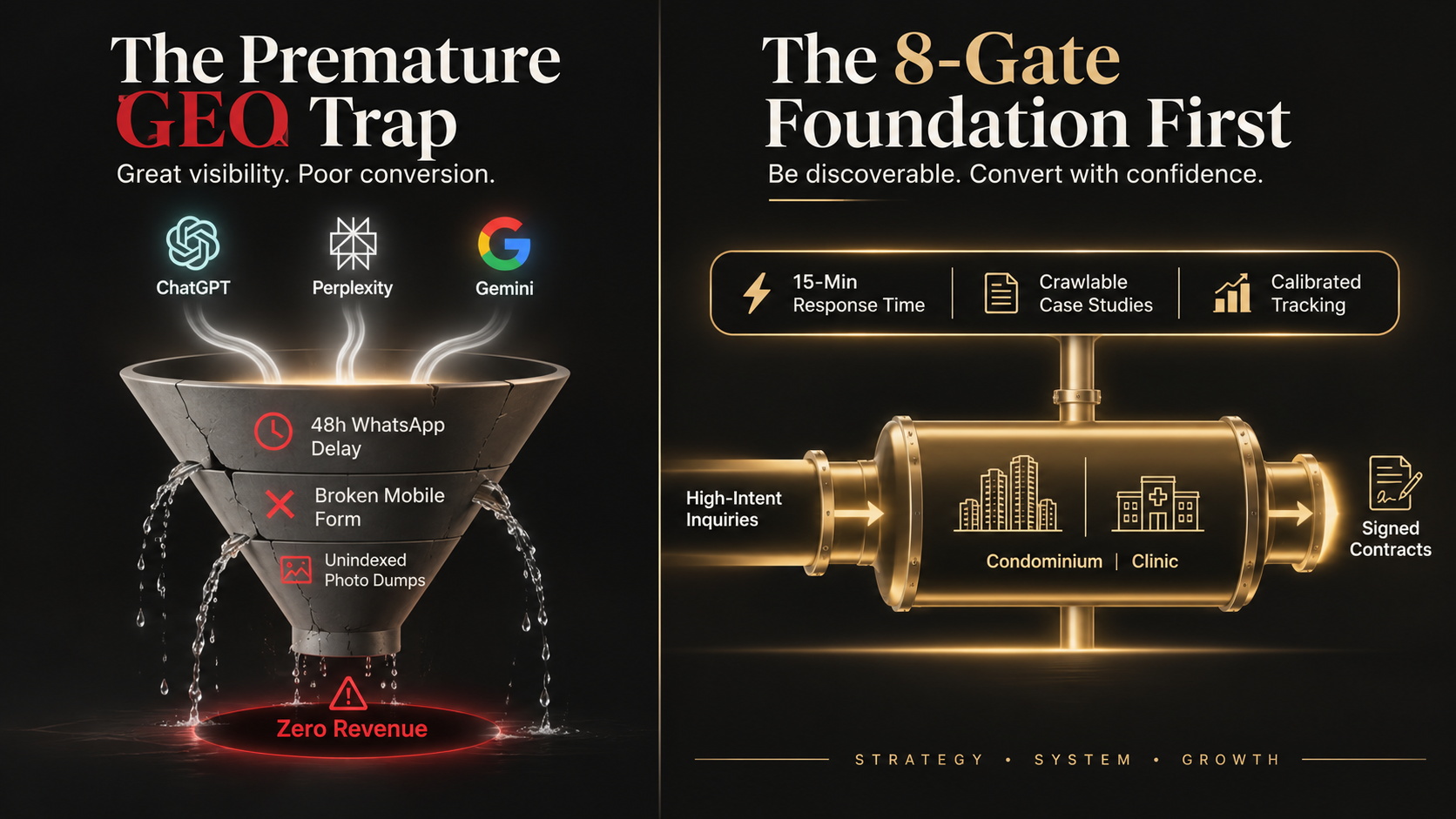 Figure 1: Pouring marketing spend into generative search visibility while internal operations leak leads is the fastest way to burn capital without driving pipeline.
Leak 1: The 48-Hour WhatsApp Black Hole
In Singapore's hyper-responsive commercial ecosystem, speed-to-lead is everything. If an affluent condominium owner submits an enquiry and your administrative staff or designers take two days to respond because they are busy on-site, that prospect has already booked a consultation with a studio along Balestier. You cannot blame search algorithms when the breakdown occurs inside your internal sales room.
Leak 2: The Portfolio Graveyard
If Googlebot cannot crawl or index your existing case studies, AI models cannot cite them. If your website is plagued by portfolio pages stuck in 'Crawled – Currently Not Indexed', your domain lacks the structural discoverability required to feed conversational retrieval engines.
Leak 3: High-Friction Booking Pathways
A prospective aesthetic patient arrives on your clinic’s landing page via mobile. The WhatsApp booking button is broken, the medical disclaimer covers the screen, or the contact form demands twelve mandatory text fields. They bounce.
Leak 4: Zero Attribution Visibility
If your leadership team cannot prove whether last month’s signed contracts originated from organic search, Meta Ads, or direct referral, adding GEO to the mix creates total chaos. Establishing custom GA4 executive reporting dashboards must precede any speculative search investment.
Fixing these operational constraints pays immediate dividends across your existing traffic. That makes operational repair an infinitely safer bet than speculative AI optimisation.
4. What Are the 8 Gates Every Singapore Founder Must Pass Before Spending on GEO?
The 8-Gate Decision Framework evaluates eight distinct commercial criteria: Buyer Relevance, Commercial Readiness, Technical Discoverability, Evidence Quality, Measurement Attribution, Internal Execution, Unit Economics, and Time Horizon. A business should only commit to a sustained GEO retainer when the majority of gates evaluate as green.
Before signing a proposal, score your studio or clinic against our 8-Gate Operational Readiness Matrix. There is no arbitrary numeric weighting; judge each gate with brutal objectivity:
| Gate | Strategic Question to Answer | Green Status (Ready to Invest) | Red Status (Do NOT Buy GEO) |
|---|---|---|---|
| 1. Buyer Relevance | Do your target clients use AI to research this purchase? | Homeowners / patients explicitly cite AI in discovery notes | Zero clients or inquiries have ever mentioned AI search |
| 2. Commercial Readiness | Does your operational team convert existing inquiries quickly? | Inquiries answered within <15 mins; high showroom show-up rate | Leads sit unread for 24+ hours; high drop-off rate |
| 3. Discoverability | Can search crawlers easily index your money pages? | Core service & case study pages indexed and valid in GSC | Key portfolio pages stuck in Crawled - Not Indexed |
| 4. Evidence Quality | Do you hold proprietary facts and proof worth citing? | Original case data, verified licenses, named medical experts | Generic marketing copy that any competitor could publish |
| 5. Measurement | Can you link closed revenue to specific search touchpoints? | GA4 attribution, call tracking, and CRM tracking active | Zero tracking; cannot prove where last month's deals came from |
| 6. Internal Execution | Does someone internally own technical updates and content? | Dedicated internal marketing lead with allocated weekly hours | Marketing is an afterthought handled in spare evening hours |
| 7. Unit Economics | Does an extra closed contract justify the retainer spend? | High-margin (5k+ clinical packages) | Low transaction value ($30 haircut / commodity repairs) |
| 8. Time Horizon | Can your cash flow comfortably absorb a 90-day learning cycle? | Patient 6-month capital runway with clear review dates | Desperate for cash flow payback within thirty days |
If three or more of these gates flash red, hiring a GEO agency is an act of commercial self-sabotage. You are attempting to run before your website can walk.
5. Which of the 4 Strategic Routes Should Your Studio or Clinic Take Today?
Based on your 8-gate diagnostic audit, your business must adopt one of four distinct strategic routes: Invest Now (if all gates are green), Run a Bounded Test (to sample AI search viability on a fixed budget), Repair Foundations (to fix broken conversion paths and crawlability first), or Defer (reallocating budget to local map packs and direct advertising).
[ THE 8-GATE AUDIT ]
                                   │
 ┌───────────────────┬─────────────┴─────────────┬───────────────────┐
 ▼                   ▼                           ▼                   ▼
[ ROUTE 1 ]         [ ROUTE 2 ]                 [ ROUTE 3 ]         [ ROUTE 4 ]
INVEST NOW          BOUNDED TEST                REPAIR FOUNDATIONS  DEFER
All gates green;    Buyer relevance is          Conversion paths or Red on relevance
scale sustained     plausible; run a 30-day     discoverability     or economics;
GEO program.        diagnostic audit.           broken; fix first.  fund local SEO/ads.
Route 1: Invest Now
- When it fits: Nearly every gate evaluates as green. Your website converts, your team responds within minutes, your core pages are cleanly indexed, and your average contract value exceeds $80,000 SGD.
- The Action: Commit to an authoritative, long-term Generative Engine Optimisation programme. Build proprietary architectural case studies, implement advanced schema, and monitor your citation trajectory using our framework on how to track AI citations across modern answer engines.
Route 2: The Bounded Test
- When it fits: Your operational foundation is sound, but you lack empirical proof that AI assistants are actively recommending competitors in your specific sub-niche.
- The Action: Do not commit to an open-ended annual retainer. Commission a tightly scoped, 30-day diagnostic sprint. Test twenty realistic buyer prompts across ChatGPT, Perplexity, and Google AI Overviews. Log which entities appear, identify citation sources, and determine whether a commercial gap truly exists.
Route 3: Repair Foundations
- When it fits: Commercial Readiness, Discoverability, or Measurement evaluates as red.
- The Action: Walk away from GEO immediately. Direct your capital toward auditing your Google Search Console logs, fixing broken mobile forms, and training your front-desk team on 15-minute speed-to-lead protocols. As we outline in our guide on brand strategy for Singapore businesses, fixing conversion friction delivers guaranteed ROI regardless of what search algorithms do next.
Route 4: Defer
- When it fits: Buyer Relevance or Unit Economics evaluates as red.
- The Action: Reallocate that budget to hyper-targeted channels with immediate commercial intent: local Google Maps 3-Pack presence and verified customer reviews. An agency that refuses to take your money when Defer is the right answer is an agency worth keeping.
6. When Should You Revisit Generative Engine Optimisation?
Businesses that defer GEO should establish explicit quarterly operational triggers to re-evaluate their decision. Triggers include sales intake logs consistently citing AI recommendations, rising referral sessions from AI domains in Google Analytics, the resolution of core indexation backlogs, or the release of high-margin service lines that support longer research horizons.
Choosing to defer GEO is not a permanent dismissal; it is a disciplined prioritization of capital.
When you decide to wait, write down the exact operational triggers that would justify reopening the conversation:
- “Our sales team logs five independent client inquiries mentioning ChatGPT in a single month.”
- “Our website achieves a stable 4% conversion rate on mobile consultation bookings.”
- “All priority condominium project case studies achieve healthy indexation in GSC.”
Assign an internal owner to review these triggers at the end of each quarter. If the market shifts and your foundational gates turn green, you enter the generative space from a position of commercial strength—not reactive fear.
7. Frequently Asked Questions
Can an agency guarantee our clinic or studio will appear in ChatGPT recommendations?
No. Generative AI models synthesize answers dynamically based on probabilistic token prediction, user location, prompt nuances, and scraped index authority. Any agency claiming they can "buy" or "guarantee" a permanent slot inside conversational AI answers is misrepresenting how the technology operates.
Is GEO just a rebranding of traditional SEO?
No, but it relies on traditional SEO as its foundation. Traditional SEO focuses on optimizing for search crawler indexing and driving blue-link clicks. GEO focuses on entity disambiguation, data extractability, and third-party authority proofing so that AI models accurately synthesize and recommend your business in conversational summaries.
How do we know if our agency is doing real GEO or just vanity reporting?
Ask to see their measurement framework. If the agency merely sends you a list of high-volume keywords or generic blog posts written by offshore content farms, they are selling traditional vanity metrics. A genuine generative search strategist audits entity schema, tracks multi-model citation share, and evaluates whether your brand solves the user's underlying commercial problem.
8. Cut Through the AI Hype with Grounded Commercial Reality
If your leadership team is feeling the pressure to spend thousands on generative search but suspects your digital foundations are leaking revenue, stop guessing.
Before you commit capital to an agency retainer, benchmark your actual marketing numbers with our Singapore project estimate calculator, or book an objective diagnostic review below.
NO FOMO. NO GUESSWORK.
Find out whether your studio or clinic is truly ready for Generative AI search—or if your capital is better spent elsewhere.
Written by the Senior Growth Strategists at 24owlsgroup — The Uncompromising Partner for Singapore High-Ticket Service Firms.