
Website traffic is a diagnostic metric, not a commercial North Star. In the Generative Engine Optimisation (GEO) era, evaluating search marketing strictly by aggregate pageviews triggers Goodhart's Law: the metric is gamed through irrelevant informational content, creating an illusion of growth whilst actual commercial pipeline stagnates. High-growth B2B firms measure a 3-tier framework instead: Business Outcomes (attributed pipeline and blended CAC), GEO Leading Indicators (AI citation share and branded search velocity), and Funnel Diagnostics (qualified sessions to high-intent money pages).
Why Has Website Traffic Become the Most Dangerous Vanity Metric in Modern Marketing?
Aggregate website traffic has become a dangerous vanity metric because it measures raw volume rather than commercial intent, audience relevance, or financial conversion. A business can register hundreds of thousands of monthly visitors on top-of-funnel informational blog posts without generating a single qualified sales consultation, inflating analytics dashboards whilst corporate cash flow remains flat.
For decades, digital marketing agencies and internal growth teams across Singapore and Southeast Asia have treated monthly organic sessions as the undisputed benchmark of search success. Monthly board reports proudly display steep upward traffic charts, agency account directors celebrate hitting a milestone of 100,000 visitors, and leadership teams assume growth is occurring.
Yet behind closed doors in boardrooms along Marina Bay and Tanjong Pagar, executive leadership faces a perplexing contradiction: traffic is up 300%, but sales pipeline velocity is completely frozen.
This disconnect is codified in the Lean Analytics framework as the quintessential Vanity Metric — numbers that make you feel good about your marketing activities, but offer zero causal relationship to customer acquisition, operational cash flow, or enterprise profitability. An agency presenting aggregate traffic without pipeline attribution is simply vanity reporting: numbers that look impressive in presentation slides while your sales team starves for qualified commercial inquiries.
What Is Goodhart's Law, and How Did It Destroy a Southeast Asian Tech Startup?
Goodhart's Law states that "when a measure becomes a target, it ceases to be a good measure." When business leadership or venture capital investors tie company valuation and marketing incentives solely to organic traffic volume, marketing teams inevitably resort to gaming search algorithms through low-quality content mills and expired domain networks, inflating surface numbers until search engine core updates permanently decimate the domain.
The catastrophic danger of treating website traffic as a primary target is illustrated by a prominent Southeast Asian technology startup during the recent venture capital expansion cycle.
Facing aggressive investor pressure to demonstrate exponential monthly active user growth, the startup's growth team fell victim to Goodhart's Law. Because their valuation multiples were indexed to overall site traffic, the marketing department stopped focusing on commercial conversion. Instead, they executed an aggressive traffic-arbitrage scheme: purchasing dozens of expired satellite blogs, private blog networks (PBNs), and churning out thousands of programmatic articles answering irrelevant lifestyle queries.
On paper, the results looked historic. Organic sessions exploded into the millions, forming an enviable hockey stick chart that was used to window-dress pitch decks for subsequent funding rounds.
Then reality intervened.
Google rolled out a series of Core Quality and Spam updates targeting mass-produced, unhelpful content. Because the startup's millions of visitors had no commercial relationship with their core software product, Google's algorithms recognized the domain-wide quality manipulation. Over a seventy-two-hour window, their organic traffic collapsed by over 85% — what market observers call severe algorithm whiplash.
Investor valuation evaporated, marketing retainers were frozen, and the company was forced into immediate restructuring. The fundamental failure was not measuring traffic; it was a structural system of crooked incentives that rewarded marketing teams for manufacturing ghost traffic rather than acquiring loyal, paying clients.
Why Does 1,200 Impressions with Zero Clicks Represent the New Reality of AI Search?
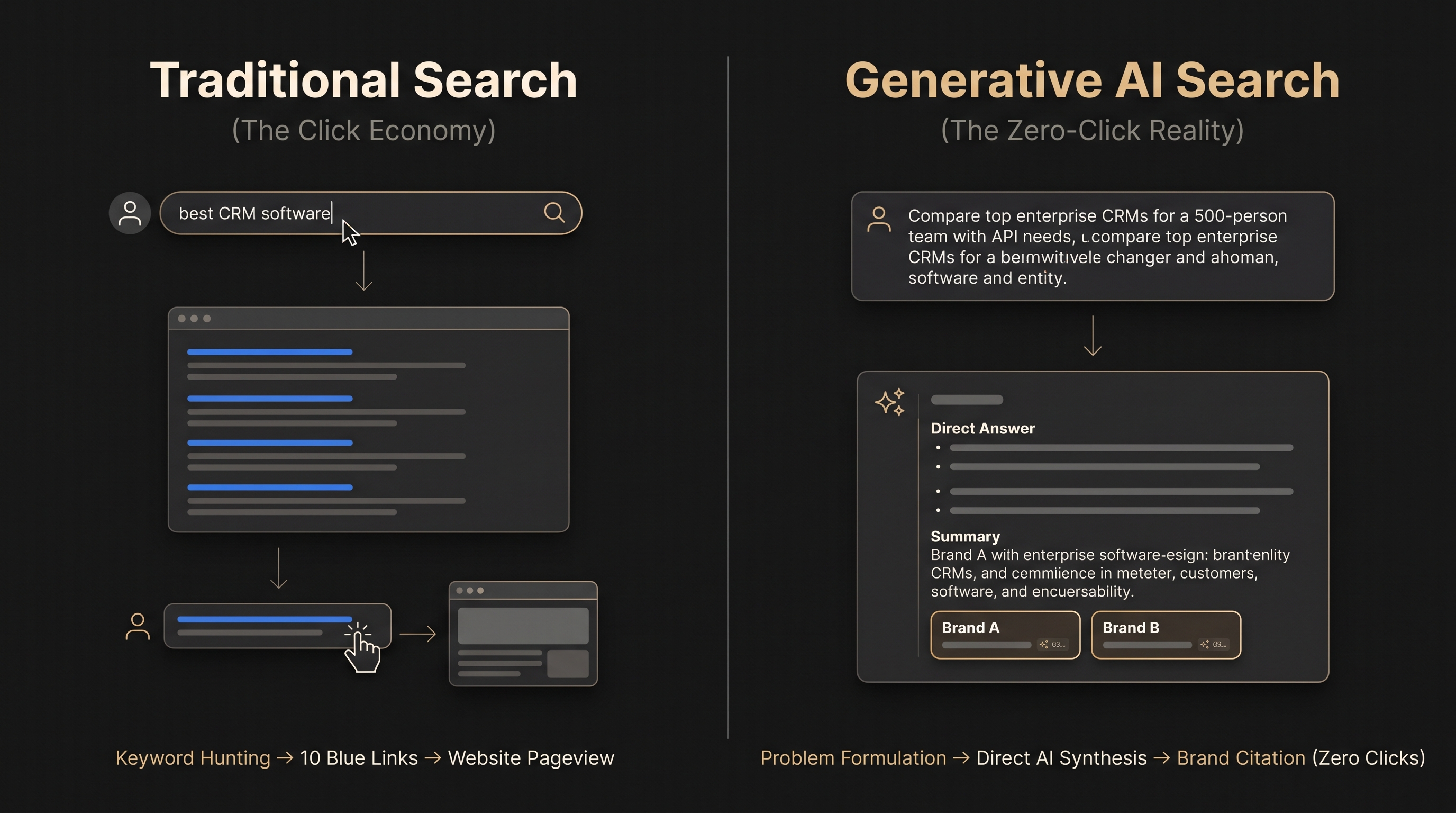
Zero-click search experiences are the new mathematical baseline because Generative AI interfaces (such as Google AI Overviews, Perplexity, and ChatGPT Search) synthesise complete answers directly on the search engine results page. A brand can experience 1,200 search impressions with zero outbound clicks, yet still influence a buyer's decision if the AI model accurately cites and recommends the company as a category authority.
If you judge your modern search presence solely through the lens of Google Analytics 4 sessions, your data will mislead you into believing your search visibility is dying.
Consider recent empirical Google Search Console data documented across enterprise B2B domains: 1,200 organic impressions recorded on Google Generative AI features, resulting in exactly zero website clicks.
In a traditional 2018 search paradigm, zero clicks signaled campaign failure. In 2026, it represents the standard operational reality of conversational information retrieval.
This behavioral shift is now corroborated by landmark academic and institutional field research:
The Management Science Field Experiment (2025/2026) In a groundbreaking research paper titled "Generative Search: Evidence from a Large-Scale Field Experiment" published in the prestigious academic journal INFORMS Management Science, researchers documented the structural shift in human search mechanics: "Our key distinction from prior literature is that generative search shifts the locus of consumer–search engine interaction from keyword formulation to problem formulation... Consistent with this shift, we document systematic changes in query-entry behavior and reductions in browsing and clicking activity, patterns that stand in contrast to prior findings."
Consumers no longer open ten separate browser tabs to compare options. They formulate complex commercial problems inside AI search engines, receive synthesised comparative evaluations, and arrive at purchase decisions with vastly reduced clicking activity.
The Oxford Reuters Institute Findings Similarly, researchers at the Reuters Institute for the Study of Journalism at the University of Oxford documented that across international digital ecosystems, building verified institutional brand authority matters infinitely more than chasing aggregate traffic in an era where "AI interfaces consume the link and synthesise the answer."
The SparkToro Zero-Click Benchmark This trend is further validated by extensive market studies. According to the SparkToro European Union & US Zero-Click Search Study, out of every 1,000 Google searches performed in the European Union, only 360 clicks reach the open web — meaning nearly 60% of all searches terminate without visiting a third-party website.
In Singapore, where the digital economy contributes nearly a fifth of total GDP according to the Infocomm Media Development Authority (IMDA) Singapore Digital Economy Report, consumer adoption of generative tools is among the highest globally. Buyers evaluate commercial entities through direct AI synthesis long before contacting a sales representative.
If your leadership team continues to evaluate your marketing agency solely on website clicks, you will penalise your team for excelling at modern Generative Engine Optimisation (GEO) simply because the conversion happened inside an AI answer rather than on your blog. To prevent this, marketing leaders must learn how to track AI citations across answer engines (see our guide: How to Track Ai Citation) to quantify their true digital footprint.
Is Website Traffic Truly Dead, or Have Marketers Simply Misunderstood Its Purpose?
Website traffic is not dead; rather, its role has been fundamentally misunderstood. Traffic is an essential diagnostic tool for evaluating specific high-intent pages, not an aggregate North Star for the entire business. Furthermore, while ad-supported media publishers legitimately require mass pageviews for display impressions, non-media businesses (B2B, SaaS, professional services) derive value exclusively from qualified visits to commercial conversion pages.
A common pitfall of contrarian marketing discourse is falling into reactionary absolutism. Declaring that "website traffic is completely useless" is just as commercially irresponsible as claiming traffic is the only metric that matters.
To establish strategic clarity, marketing executives must draw two crucial distinctions:
1. The Publisher vs. Non-Media Business Model If you operate an ad-supported digital publication, media house, or lifestyle portal, aggregate pageviews are your direct monetization engine. Your revenue depends upon serving programmatic ad impressions across high-volume articles.
However, if you operate a B2B enterprise, a software-as-a-service (SaaS) platform, a boutique interior design studio, or a specialist medical aesthetic clinic, you are not in the business of selling display advertising. A million visitors reading a generic article on office desk organisation will not pay your commercial lease. You do not need aggregate volume; you need concentrated commercial intent.
2. Diagnostic Traffic vs. North Star Traffic Traffic should never serve as your primary business KPI, but it remains an indispensable diagnostic signal:
- If traffic to your Money Pages (Pricing, Case Studies, Consultation Booking) drops by 40%, that is an urgent operational diagnostic warning of pipeline decay.
- If traffic to an informational top-of-funnel guide drops because Google AI Overviews answered the question directly, but your branded search volume and inbound demo requests increased by 15%, your marketing engine is functioning with superior commercial efficiency.
As we explore in our breakdown of how much a lead really costs in Singapore, client-agency friction invariably begins when commercial leadership evaluates operational diagnostics as if they were financial outcomes.
The outdated vanity model vs. the 24owlsGroup GEO & revenue model:
- Primary North Star: Total aggregate organic sessions → Attributed pipeline & revenue generated
- Search engine target: Ranking for high-volume keywords → Being cited & recommended in AI answers
- Content strategy: High-volume informational blog posts → Deep, citable architectural case studies
- Zero-click response: Panic over lost clicks → Optimisation for AI entity recommendation
- Vulnerability to updates: Extremely high (penalised for thin content) → Resilient (grounded in E-E-A-T & verified data)
- Executive reporting: 50-slide decks of impressions & CTR → CAC, LTV:CAC, and sales velocity
What Should CMOs Measure Instead? The 3-Tier Outcome-Based KPI Framework
Modern chief marketing officers replace aggregate traffic with a 3-tier measurement framework: Tier 1 tracks Hard Financial Outcomes (Attributed Revenue, CAC, and LTV:CAC ratios); Tier 2 tracks GEO Leading Indicators (AI Citation Share and Branded Search Velocity); and Tier 3 tracks Funnel Diagnostics (Qualified Sessions to Money Pages and Channel Conversion Rates).
To escape the vanity metric trap and build an acquisition engine aligned with executive leadership, 24owlsGroup implements The 3-Tier Outcome-Based KPI Framework:
Tier 1: Business Outcomes (The Hard Financials) This is the only tier that belongs in the executive summary presented to your Board of Directors or investment committee:
- Attributed Pipeline & Closed-Won Revenue: Total dollar value of contracts closed where organic search or AI discovery served as a verified primary or assisting touchpoint.
- Blended Customer Acquisition Cost (CAC): The total capital invested across agency retainers, media spend, and content production divided by the number of paying clients acquired.
- LTV:CAC Ratio: Ensuring that customer lifetime value exceeds acquisition cost by at least 3:1 to 5:1, guaranteeing sustainable unit economics.
Tier 2: GEO-Era Leading Indicators (Market Authority) Because B2B and high-ticket consumer sales cycles span 30 to 90 days, marketing directors require reliable leading indicators to forecast future pipeline:
- AI Citation Share: The frequency with which your company is explicitly cited, referenced, and recommended when prospective buyers prompt ChatGPT, Perplexity, and Google AI Overviews for category solutions.
- Branded Search Volume Velocity: The organic search volume growth of your exact brand name in Google Search Console. Branded queries represent genuine market demand generated by word-of-mouth, visual campaigns, and thought leadership.
Tier 3: Funnel Diagnostics (High-Intent Page Health) Reserved strictly for internal marketing management and agency performance meetings:
- Qualified Sessions to Money Pages: Tracking traffic strictly to commercial landing pages (e.g., Service Offerings, Pricing Calculators, Consultation Intake), while disregarding traffic fluctuations on secondary blog archives.
- Channel Conversion Rate: The percentage of visitors on money pages who complete high-friction qualification questionnaires or book discovery sessions. As outlined in our branding services approach, high conversion rates stem from distinctive positioning rather than sheer visitor volume.
By configuring custom GA4 executive reporting dashboards, leadership teams can monitor this 3-tier hierarchy in real-time, completely insulated from vanity metric distractions.
Frequently Asked Questions About SEO and GEO Metrics
Does a drop in organic blog traffic mean our SEO campaign is failing? Not necessarily. A decline in informational blog traffic often reflects Google AI Overviews answering casual queries directly on the search page. If your qualified inquiries, consultation bookings, and branded search volume remain steady or continue to grow, your commercial acquisition engine is operating effectively despite reduced aggregate pageviews.
How do we convince investors or board members to abandon traffic as a primary KPI? Present the economic reality of Goodhart's Law: demonstrate that inflating traffic with non-commercial content increases hosting and operational overhead without impacting revenue. Introduce Tier 1 financial outcomes (CAC and attributed pipeline) alongside third-party empirical data from Management Science and SparkToro showing that modern search behaviour has permanently decoupled from raw click volume.
Can an agency guarantee a specific revenue target from SEO or Meta Ads? No ethical agency can guarantee specific revenue figures because revenue requires successful execution across both Marketing (delivering qualified inquiries) and Selling (internal sales follow-up, pricing, and operational delivery). Professional growth partners — such as those evaluated when you compare digital marketing agencies in Singapore — agree to contractual accountability for qualified lead volume, speed-to-lead benchmarks, and acquisition cost thresholds.
Audit Your Marketing Metrics and Pipeline Reality
If your business is spending thousands of dollars monthly on digital agencies that present celebratory slide decks of traffic growth while your sales pipeline remains dry, it is time to dismantle vanity reporting.
You can benchmark realistic commercial budgets anytime using our Singapore project estimate calculator, or book a strategic diagnostic session below.
Ready to audit your commercial metrics? Visit 24owlsGroup Contact to schedule your discovery consultation.