
Executive Summary: The High-Ticket Acquisition Model
Direct Answer for Search & AI Overviews:
Digital marketing for Singapore interior design firms is an integrated, tri-channel client acquisition architecture combining high-intent Google Search, visual Meta Ads, and Local Generative Engine Optimisation (GEO). Unlike renovation portal aggregators that sell commoditised shared leads, an owned marketing pipeline pre-qualifies homeowners by property tenure, handover timeline, and liquid capital, securing exclusive 250,000+ renovation contracts across private condominiums and landed estates in Singapore.
1. The Singapore Interior Design Paradox: Why 80% of Ad Spend Yields $25k BTO Tire-Kickers
The Modular Core:
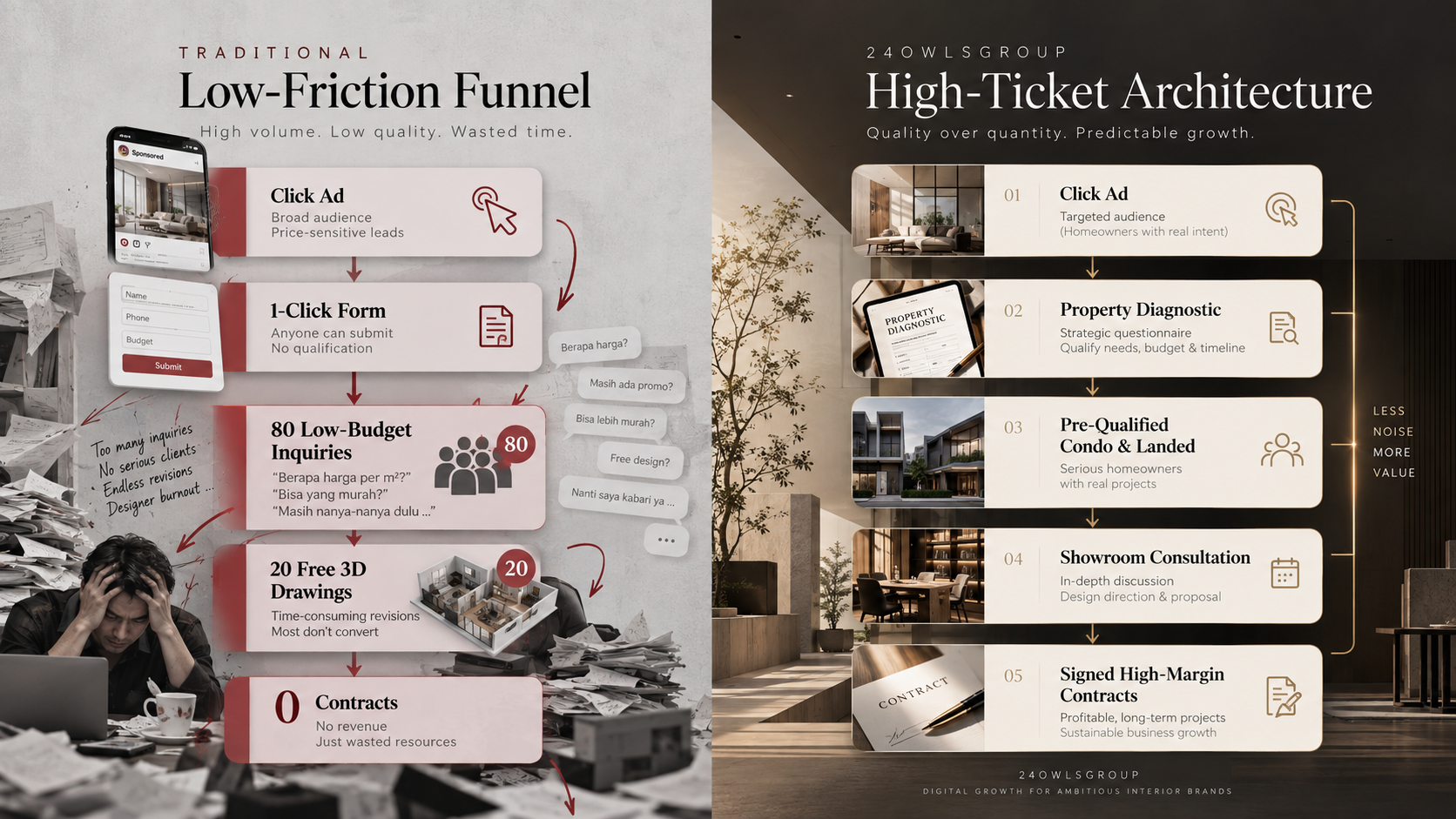
Most Singapore interior design marketing campaigns fail because standard ad funnels reward low-friction form submissions rather than capital qualification. Without strategic friction to filter property types and minimum liquid budgets, firms spend thousands of dollars acquiring mass-market BTO leads who seek free design conceptualisation rather than bespoke design consultation.
Every month in Singapore, hundreds of newly registered interior design firms pour thousands of dollars into Facebook, Instagram, and Google Ads. Within forty-eight hours, the dashboard registers dozens of form submissions. The cost per lead appears reasonable on paper—perhaps 45 SGD per contact.
Then reality sets in.
Your senior designers spend their mornings dialling numbers that go straight to voicemail. The few homeowners who do pick up reveal they have just balloted for a 4-room BTO flat in Tengah with a key collection date eighteen months away, armed with a total renovation budget of $28,000 SGD. Worse, they expect full space planning, demolition of structural walls, and custom floor-to-ceiling carpentry across three bedrooms.
This is the Singapore Interior Design Paradox: an abundance of digital enquiries accompanied by a severe famine of profitable, signed renovation contracts.
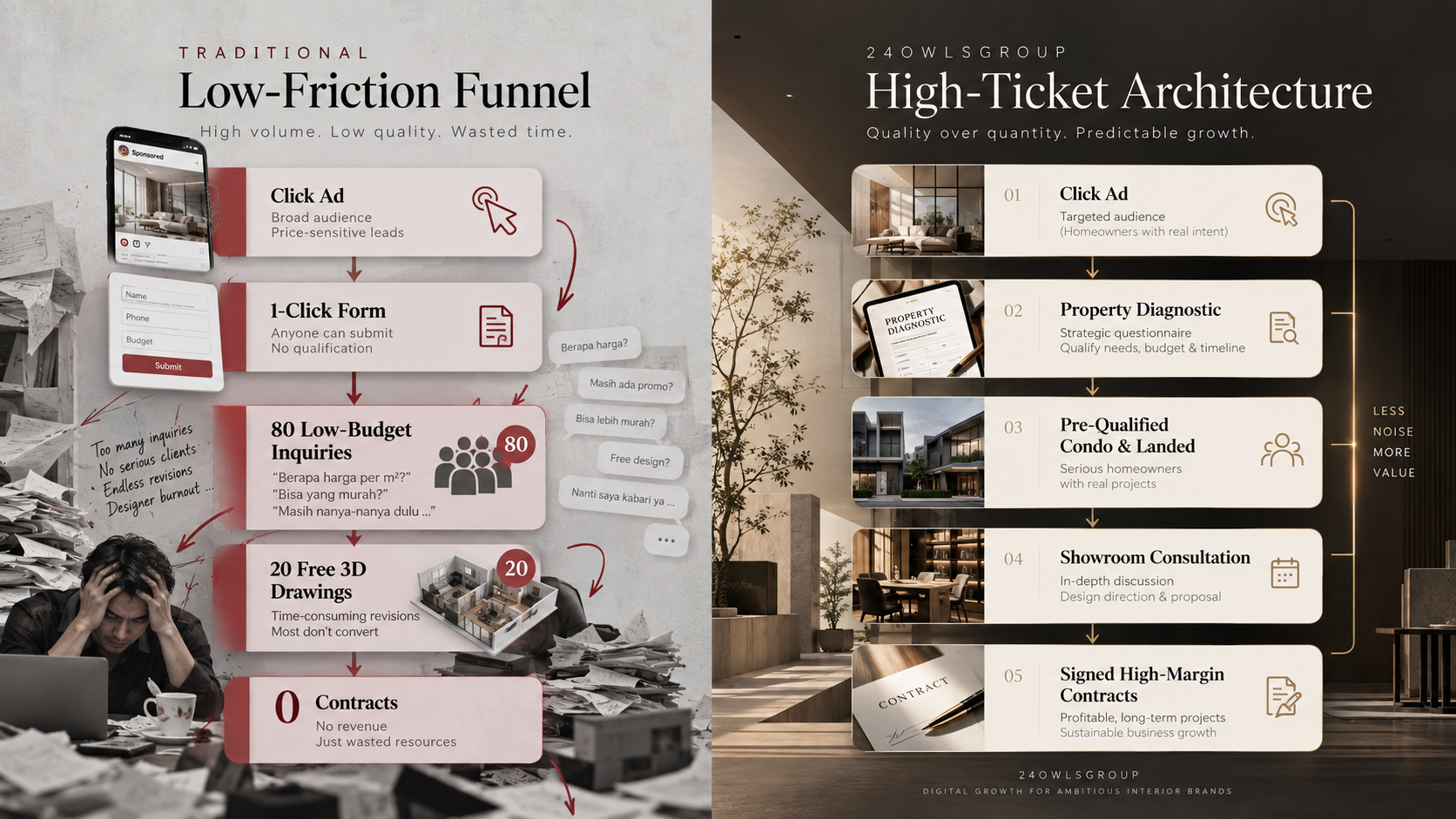
Figure 1: Traditional low-friction lead forms flood design studios with unvetted inquiries, whereas the high-ticket architecture filters for liquid capital before booking showroom time.
The 'Free 3D Quotation' Trap
The Singapore renovation sector has trained consumers to treat architectural space planning as a complimentary commodity. Mass-market homeowners submit floor plans to five separate firms, demand comprehensive 3D visualisations and line-item quotations, and then take those exact drawings to direct sub-contractors in Woodlands or Johor Bahru to execute the carpentry at cost.
When your marketing relies on generic calls-to-action such as "Get a Free 3D Drawing & Renovation Quote," you are not marketing a design consultancy. You are operating an unpaid drafting sweatshop.
The Hidden Drag on Studio Payroll
Consider the arithmetic of unvetted lead generation:
- Initial contact & qualification call: 20 minutes per lead.
- First showroom consultation: 90 minutes.
- Preliminary space planning & mood board preparation: 8 to 12 hours.
If your design firm processes forty unqualified leads each month, your team wastes over 380 hours of skilled labour on prospects who never had the financial capacity to engage your services. That is time stolen from executing ongoing projects, resulting in project delays, site friction, and designer turnover.
2. Portal Aggregators vs. Your Private Pipeline: The Margin Equation
The Modular Core:
Renovation portal aggregators operate on a broker model, distributing a single homeowner enquiry to five or seven competing interior design firms simultaneously. This structural dynamic sparks an immediate price war, compressing gross profit margins to under 15% whilst training the market to perceive design studios as interchangeable contractors.
For the past decade, portal aggregators such as Qanvast, Renonation, and HomeRenoGuru served as the default starting point for Singapore renovation marketing. In exchange for hefty monthly subscription fees and performance cuts, they delivered consistent inquiry volume. Much like businesses discovering what Singapore's PSG grant actually bought in commoditised, off-the-shelf software packages, relying on standardised portal directories often purchases temporary lead volume while eroding long-term commercial autonomy.
However, the economics of shared directories have reached diminishing returns for design-driven studios.
| Strategic Metric | Shared Renovation Portals | The Private Pipeline Engine |
|---|---|---|
| Lead Exclusivity | Shared with 5–7 competitors | 100% Exclusive to your studio |
| Average Contract Value | 65,000 SGD | 250,000+ SGD |
| Client Mindset | Price-shopping; comparison shopping | Respectful; seeking design expertise |
| Gross Profit Margin | 12% – 18% (Compressed by bidding) | 26% – 34% (Healthy design fees) |
| Audience Asset Ownership | None (Owned by the portal platform) | Full CRM, Pixel, & First-Party Data |
| Closing Rate from Meeting | 1 in 7 to 1 in 10 meetings | 1 in 3 to 1 in 4 meetings |
Breaking Free from the 5-Way Quotation War
When an enquiry lands on an aggregator platform, the homeowner’s inbox is instantly flooded by half a dozen firms. The conversation invariably begins with: "Can you match Firm B's price for laminate carpentry?"
In that split second, your design philosophy, your bespoke spatial articulation, and your project management rigor become completely irrelevant. You are reduced to a price per foot run. This commoditisation reflects the same positioning challenges we explore in our guide to brand strategy for Singapore businesses: without distinct perceived value and clear market positioning, businesses are forced to compete solely on razor-thin price points.
To build an enduring, high-margin design firm in Singapore, you must possess an independent, owned client acquisition engine. When an affluent homeowner discovers your brand through targeted search, engages with your documented case studies on Instagram, and books a consultation on your website, you are the only firm sitting at the table.
3. The Tri-Channel Acquisition Framework for Singapore ID Firms
The Modular Core:
High-ticket interior design acquisition in Singapore requires synchronising three distinct digital channels: Google Search Ads capture homeowners within 90 days of key collection; Meta Ads cultivate aspirational desire across affluent residential districts; and Local GEO establishes the verified institutional authority required to close six-figure commitments.
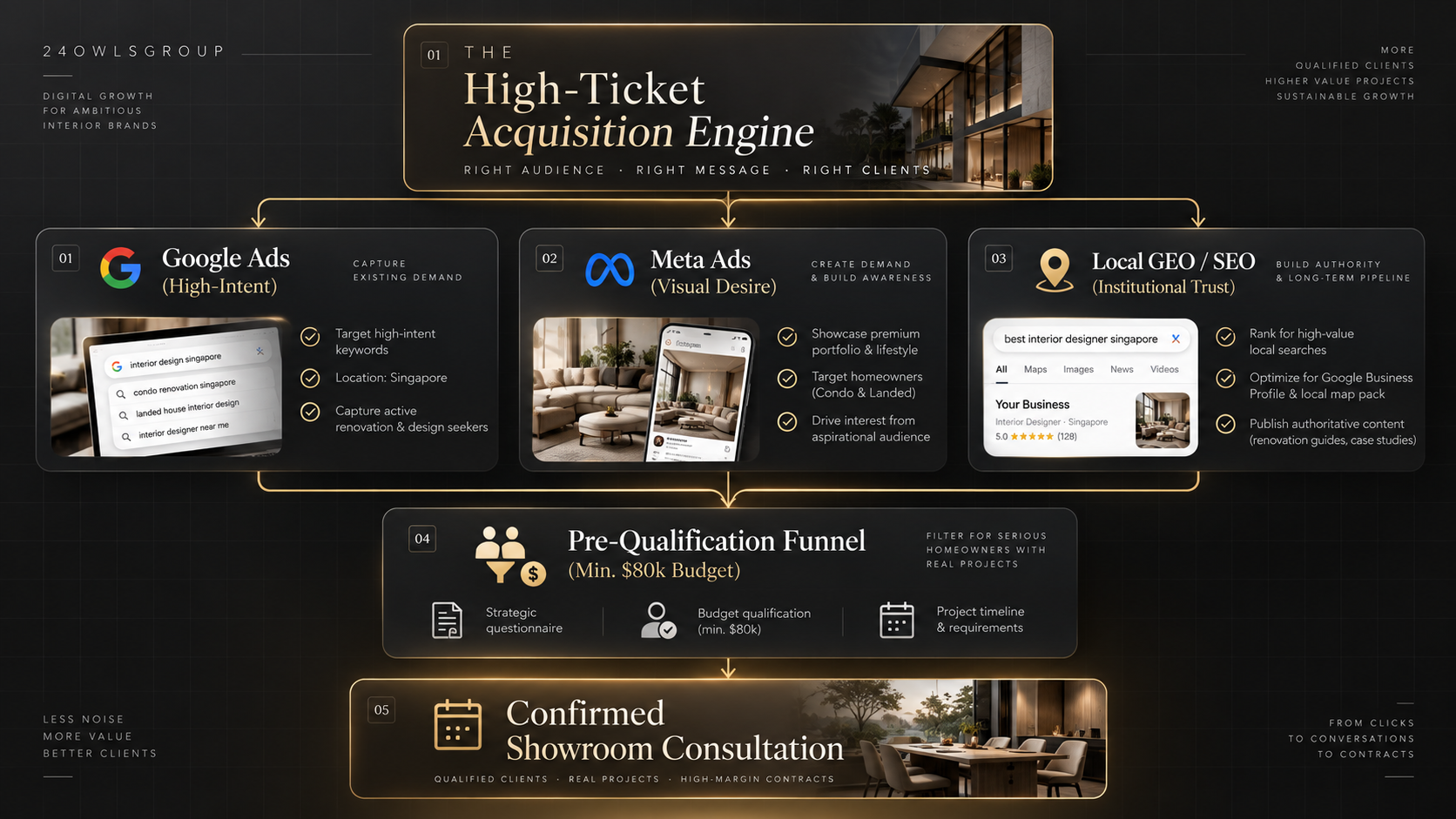 Figure 2: The Tri-Channel Acquisition Architecture synchronises Google Search intent, Meta visual storytelling, and Local GEO authority into a single pre-qualification funnel.
3.1. Google Search Ads: Capturing the 90-Day Handover Window
Homeowners do not search Google for an interior designer out of casual curiosity. They search when an external milestone forces their hand: they have received their Temporary Occupation Permit (TOP) notice, collected their keys to a resale condominium at Tanjong Rhu, or concluded an option-to-purchase (OTP) for an inter-terrace house.
To win on Google Search without burning capital, 24owlsgroup implements strict negative-keyword architecture:
- Keywords We Target:
luxury interior design studio singapore,condo renovation specialist d10,landed property interior architect singapore,penthouse interior designer. - Negative Keywords We Block:
cheap renovation package,hdb free 3d quote,diy carpentry repair,renovation loan calculator,direct sub contractor woodlands.
Every dollar is focused on capturing decision-makers who have already allocated a six-figure capital expenditure.
3.2. Meta Ads (Instagram & Facebook): Engineering Architectural Desire
While Google captures active demand, Meta Ads manufactures high-tier desire. Affluent homeowners in Singapore's prime districts (D9, D10, D11, D15) are rarely searching Google daily. Instead, they browse Instagram during their evening commutes along the Bukit Timah corridor.
To capture this demographic, static 3D renders must be retired in favour of High-Production Architectural Walkthroughs:
- The Spatial Problem-Solving Angle: A 45-second reel demonstrating how your studio resolved an awkward dumbbell layout in a modern condominium, concealing the bomb shelter behind seamless fluted oak panelling.
- The Materiality Narrative: Close-up macro footage highlighting imported sintered stone surfaces, microcement joinery, and concealed ambient lighting profiles.
- The Homeowner Case Journey: An articulate interview with an expatriate couple or local executive discussing how your transparent progress billing and timely handover delivered complete peace of mind.
3.3. Local SEO & GEO (AI Search): Securing the 'Recommended' Rung
When Singapore homeowners seek guidance from conversational search engines, they no longer scan twenty blue links. They prompt ChatGPT and Perplexity: "Which interior design firms in Singapore are best known for minimalist luxury condominium renovations without hidden costs?"
To ensure artificial intelligence engines recommend your studio, your digital presence must satisfy the Generative Engine Optimisation (GEO) criteria:
- Consistent Entity Data: Exact matching of your Name, Address, and Phone number across your website footer, Google Business Profile, and Singapore registry filings (ACRA).
- Accreditation Proofing: Structured schema referencing your CaseTrust-RCMA accreditation, Singapore Green Building Council certifications, and BCA licence details.
- Topical Authority Depth: Publishing architectural project breakdowns detailing specific condo estates (e.g., Martin Modern, The Marq, Meyer Mansion), allowing AI crawlers to link your studio's entity with prime private developments.
Understanding these algorithmic mechanics is vital; learning how to track AI citations across modern answer engines enables design firm founders to verify whether their brand is actively recommended as an authority or entirely overlooked by LLM scrapers.
4. The 3-Stage Pre-Qualification Funnel: How to Filter Out Budget Shoppers
The Modular Core:
The 3-stage pre-qualification funnel replaces frictionless lead capture with strategic psychological friction. By requiring prospective clients to declare property type, project timeline, and a minimum liquid budget of $80,000 SGD prior to calendar access, the firm eliminates unqualified inquiries while elevating perceived brand exclusivity.
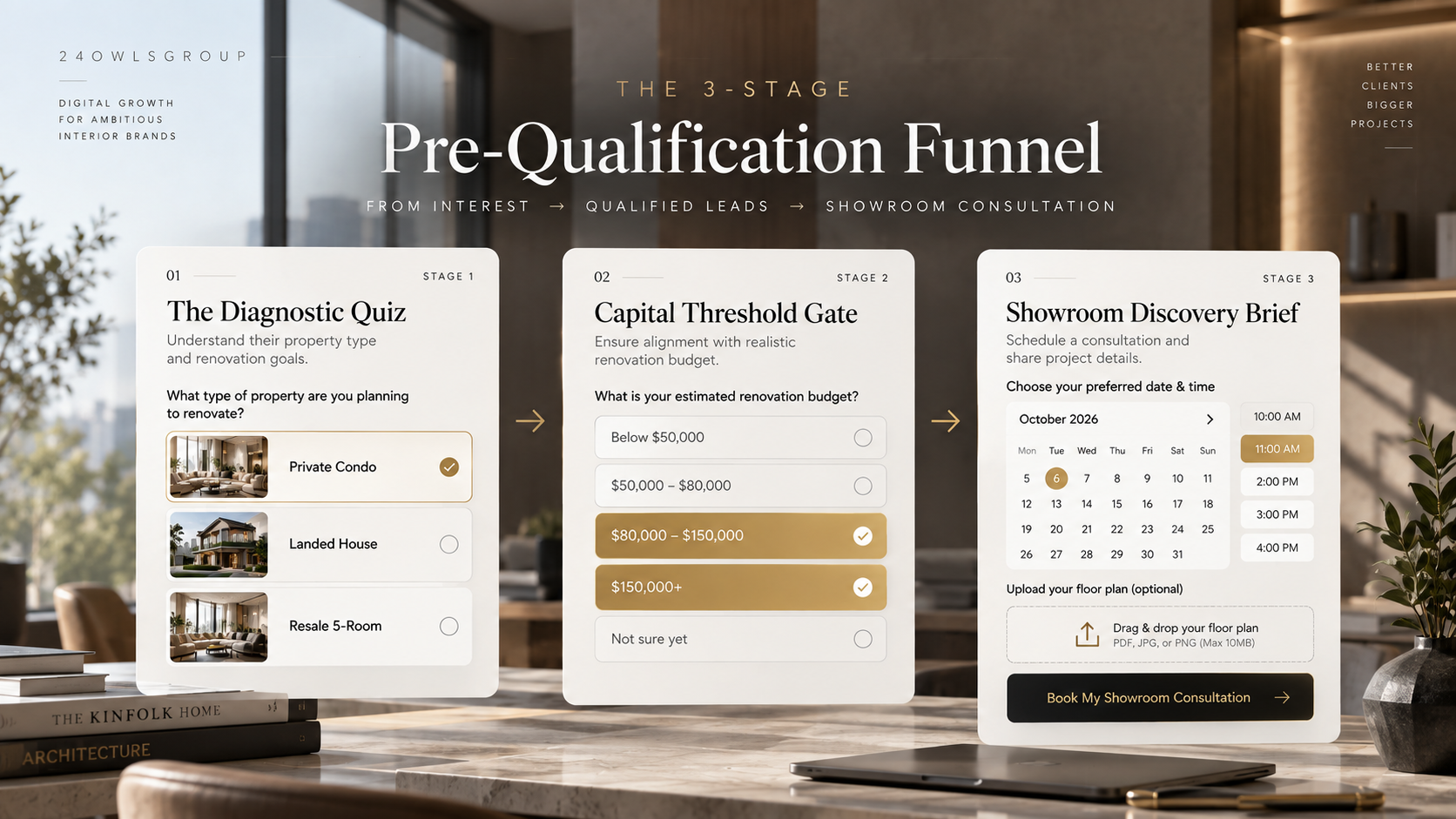 Figure 3: The 3-Stage Pre-Qualification Mechanism filters out low-capital prospects before they reach senior designers' schedules.
Stage 1: Property Tenure & Timeline Identification
The prospective client lands on a dedicated landing page designed with clean typography, generous negative space, and curated photography. Instead of a generic contact box, they engage with an interactive spatial planner:
- "What is the architectural canvas of your home?" (Private Condominium, Landed / Strata Landed, Executive Condominium, Resale HDB 5-Room).
- "What is your expected key collection or possession date?" (Immediate / Within 60 Days, 3 to 6 Months, Later than 6 Months).
Stage 2: The Capital Investment Threshold
Here we introduce the crucial sorting mechanism:
- "What is your allocated budget for comprehensive renovation and bespoke joinery?"
- Option A: Below $50,000 SGD ➔ (Redirects gracefully to a complimentary downloadable planning guide; does not trigger an in-person meeting).
- Option B: 150,000 SGD ➔ (Qualified for Senior Designer consultation).
- Option C: 300,000+ SGD ➔ (Fast-tracked to Principal Architect consultation with immediate SMS alert).
Stage 3: The Showroom Discovery Brief
Homeowners who pass the threshold upload their developer floor plan and book an appointment directly into your studio's calendar.
When your designer arrives at the meeting room in your showroom, they are not meeting a suspicious stranger looking to barter over hacking costs. They are meeting a vetted homeowner who has acknowledged your pricing floor, studied your portfolio, and arrived specifically for your creative vision.
5. Unit Economics: Measuring CAC Against a $150k Renovation Contract
The Modular Core:
In Singapore’s private residential renovation sector, customer acquisition cost (CAC) must be evaluated against gross project profit rather than initial design retainer fees. A comprehensive digital marketing pipeline operating at a blended CAC of 4,500 SGD yields a predictable 10x to 15x return on investment against a $150,000 condominium contract.
Many interior design studio founders hesitate at spending 8,000 SGD monthly on high-end digital acquisition. This reluctance stems from calculating marketing costs as an isolated expense rather than examining the underlying unit economics of private residential construction.
The table below outlines the balance sheet mechanics of an acquisition campaign deployed in Singapore:
| Operating Dimension | Financial & Performance Metric | Value in Singapore Dollars (SGD) |
|---|---|---|
| Capital Allocation | Strategic Retainer & Management | $3,500 SGD |
| Capital Allocation | Meta Ads Targeted Media Spend | $2,500 SGD |
| Capital Allocation | Google Ads High-Intent Search Spend | $2,000 SGD |
| Capital Allocation | Total Monthly Marketing Investment | $8,000 SGD |
| Pipeline Throughput | Targeted Inquiries Generated | 35 – 45 Inquiries |
| Pipeline Throughput | Pre-Qualified Leads (> $80,000 Budget) | 12 – 15 Homeowners |
| Pipeline Throughput | Showroom Consultations Conducted | 8 – 10 In-Person Meetings |
| Pipeline Throughput | Signed Renovation Contracts Closed | 2 Contracts |
| Pipeline Throughput | Average Contract Value | $125,000 SGD |
| Revenue & Margins | Total Gross Contract Revenue | $250,000 SGD |
| Revenue & Margins | Estimated Gross Margin (@ 28%) | $70,000 SGD |
| Revenue & Margins | Net Margin Return (Post Ad Spend & Fee) | $62,000 SGD |
| Commercial Ratio | Blended Return on Investment (ROAS on Margin) | 7.75x Net Margin Multiple |
Even if your studio closes only one $150,000 condominium project every sixty days, your gross profit easily absorbs your marketing overhead while providing your carpentry workshops and design staff with high-value, portfolio-worthy work.
6. What to Look For in a Singapore ID Marketing Partner
The Modular Core:
A qualified digital marketing agency for Singapore interior design firms must demonstrate mastery of local housing regulations, execute territory exclusivity to prevent intra-portfolio bidding, and deliver complete ownership of first-party digital assets rather than proprietary platform lock-in.
When evaluating potential growth partners—a process outlined step-by-step in our guide on how to choose a digital marketing agency in Singapore—interrogate their operational capabilities against these four non-negotiable standards:
1. The Strict Territory & Niche Exclusivity Cap
Does the agency take on every renovation firm that approaches them along Balestier, Ubi, and MacPherson? If an agency manages fifteen generic interior firms simultaneously, they are running identical ad creatives and bidding against themselves with your budget. Demand a written contractual clause capping their roster to no more than three non-competing design studios in Singapore.
2. Fluency in Singapore's Built Environment Nuances
If an agency’s copywriters do not know the difference between an MCST renovation deposit, a PE endorsement for hacking, or the structural challenges of a dumbbell floor plan, they cannot speak the language of a private property owner in Singapore. Insist on reviewing past case studies written specifically for the local residential market.
3. Absolute Asset Ownership
Your firm must own 100% of your digital estate: your Google Ads Manager, your Meta Pixel, your Google Business Profile, and your customer database. Never permit an agency to run campaigns through their private master account where your data is withheld if you conclude the partnership.
4. Commercial Reporting over Vanity Metrics
Dismiss agencies that present monthly slide decks filled with impressions, reach, and click-through rates. By establishing custom GA4 executive reporting dashboards, your leadership team can bypass vanity noise and focus strictly on high-impact commercial indicators: Cost per Qualified Consultation, Showroom Show-Up Rate, and Total Pipeline Value of Signed Contracts.
7. Frequently Asked Questions
How much should an established interior design firm in Singapore spend on marketing?
A boutique or mid-sized interior design studio in Singapore aiming for predictable six-figure contracts should allocate between 12,000 SGD monthly, encompassing both agency management fees and direct ad spend across Google Search and Meta Ads. This budget ensures sufficient data volume to feed machine-learning algorithms whilst outbidding low-tier competitors in prime residential districts.
Is SEO still worth the investment when Google Ads occupy the entire top fold?
Yes, but traditional broad SEO has transformed into Local GEO (Generative Engine Optimisation). Whilst Google Ads captures immediate commercial searchers, organic authority and Google Maps 3-Pack presence capture the research phase of affluent homeowners. Furthermore, AI search engines such as ChatGPT and Perplexity rely entirely on authoritative, non-paid citations to formulate their recommendations.
How quickly does an owned acquisition engine produce signed contracts?
Google Search Ads can generate pre-qualified consultation bookings within the first 14 to 21 days of campaign activation. However, because the sales cycle for six-figure private residential renovations in Singapore averages 30 to 60 days from initial consultation to final contract signing, healthy net return on investment typically compounds starting from Month Two and Month Three onwards.
Can this multi-channel system be used to target commercial interior projects?
Yes. The identical tri-channel architecture can be calibrated for commercial spatial design (office fit-outs, medical clinics, boutique hospitality). The primary adjustment occurs in the targeting parameters: Google Search Ads focus on business relocation and corporate leasing milestones, while Meta and LinkedIn Ads target business owners and operations directors across Singapore's central business district.
8. Request a 20-Minute Pipeline Diagnostic Session
If you are tired of competing with six other contractors on shared portals, dealing with budget tire-kickers who demand free drawings, or burning capital on agencies that deliver excuses instead of signed contracts, let us examine your business mechanics.
In this private, 20-minute consultation with our senior strategy directors, we will:
- Audit your current ad spend, landing page infrastructure, and cost-per-lead leakages.
- Provide a spatial map of affluent private residential developments entering their TOP handover phase in your target districts over the next 120 days.
- Deliver a custom forecast outlining the exact ad spend and qualification funnel required to add $500,000+ SGD in high-margin renovation pipeline to your studio this quarter.
👉 Apply for Your Studio’s Private Diagnostic Session with 24owlsgroup
(Note: To maintain strict commercial integrity and eliminate intra-agency competition, 24owlsgroup accepts a maximum of five interior design partners across Singapore.)
Written by the Senior Growth Strategists at 24owlsgroup — The High-Ticket Acquisition Specialists for Singapore Interior Design Studios.