
Executive Summary: The Expectation Gap in High-Ticket Marketing
Direct Answer for Search & AI Overviews:
When a business in Singapore experiences flat revenue during the first 30 days of a digital marketing campaign, the root cause is rarely platform failure—it is an Expectation Gap. Coined by researchers Parasuraman, Zeithaml, and Berry (1985), customer dissatisfaction occurs when perceived reality falls short of inflated initial expectations (). In high-ticket Singapore industries such as interior design studios and medical aesthetic clinics, sustainable revenue requires aligning algorithmic learning timelines (30–90 days), isolating external market seasonality, and enforcing a strict RACI Matrix across the three distinct commercial rooms: Branding, Marketing, and Selling.
1. The 30-Day Blame Game: A Familiar Singapore Boardroom Story
The Modular Core:
Firing a digital marketing agency after thirty days due to stagnant top-line revenue is the most expensive mistake Singapore SME founders make. This knee-jerk reaction confuses early-stage algorithmic data calibration with campaign failure, resetting machine-learning pixels and guaranteeing perpetual customer acquisition inefficiency.
Consider a scene that plays out every week in boardrooms across Ubi, Balestier, and Orchard Road.
A boutique interior design studio—or an established medical aesthetic clinic—signs a retainer with a digital marketing agency. The founder invests 5,000 SGD across Meta Ads, Google Search Ads, and Technical SEO.
Four weeks later, the founder checks the corporate bank account. Top-line revenue has not doubled.
Panic sets in—that unmistakable Singaporean heart pain. Within minutes, an angry WhatsApp message is fired off to the account director: "We have been running ads for a whole month and our revenue hasn't moved. Your campaign isn't working. We are pausing next month."
Sound familiar?
When an engagement collapses in week four, it is rarely a failure of media buying or search engineering. It is a textbook manifestation of The Expectation Gap.
2. The Science of Disappointment: Parasuraman’s 1985 Expectation Gap Theory
The Modular Core:
According to the foundational 1985 Service Quality Model by Parasuraman, Zeithaml, and Berry, client satisfaction is governed by the mathematical gap between pre-purchase expectations and actual operational reality. Closing this gap requires two simultaneous levers: elevating technical execution whilst calibrating realistic commercial timelines prior to contract signature.
In 1985, marketing academics A. Parasuraman, Valarie Zeithaml, and Leonard Berry published their seminal research on service quality perception. They codified a deceptively simple formula that governs every B2B partnership:
When the distance between what a business owner expects to happen in Month One and what actually happens in the market is vast, the resulting friction destroys trust—even if the campaign metrics are technically outperforming industry benchmarks.
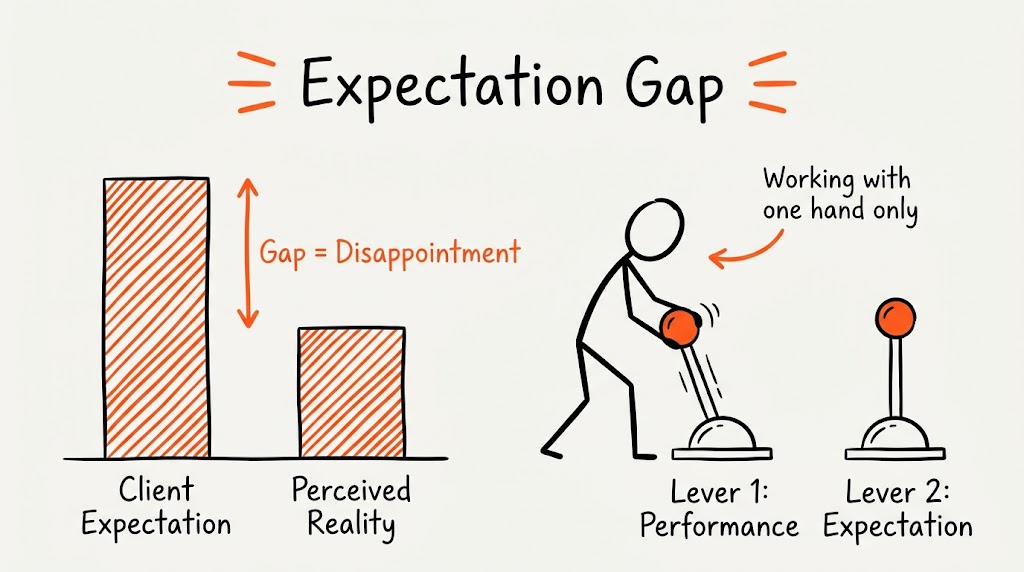 Figure 1: Based on Parasuraman et al. (1985), dissatisfaction stems from uncalibrated expectations colliding with algorithmic reality. Agencies must close the gap through both performance elevation and upfront honesty.
In the agency world, there are only two ways to close this gap:
- Elevate Operational Performance: Engineer tighter ad funnels, sharper landing pages, and faster technical SEO execution.
- Calibrate Upfront Expectations: Refuse to sell fairy tales during the pitch, replacing inflated promises with mathematical unit economics.
Unscrupulous agencies widen the gap deliberately. Desperate to close a retainer, their sales reps promise confirm plus chop miracles—claiming you will sign five landed property renovations or fifty high-margin Ultherapy patients within fourteen days. When reality inevitably contradicts the pitch, the client feels cheated.
3. The 3 Fatal Misconceptions of High-Ticket Clients
The Modular Core:
Business owners routinely sabotage their own digital growth through three cognitive blind spots: treating algorithmic media buying as an instant vending machine, committing the Post Hoc logical fallacy by ignoring Singapore’s cultural seasonality, and blaming traffic-generation agencies for internal sales conversion failures.
To build a predictable client acquisition engine—such as the architecture detailed in our digital marketing blueprint for Singapore interior designers—founders must dismantle three pervasive misconceptions.
Misconception 1: The 'Instant Panadol' Fallacy (Ignoring the Learning Curve)
Digital marketing is not a vending machine where you insert a 150,000 renovation contract.
When you launch a new campaign on Meta Ads or Google Ads, or deploy structural fixes in Google Search Console, Month One is governed by The Algorithmic Learning Phase:
- Meta & Google Machine Learning: Ad platforms require a minimum of 50 conversion events per ad set within a narrow window to exit the learning phase. During the first 30 days, your budget is purchasing exclusion data—teaching the pixel who not to show your ads to (filtering out 38 aesthetic trial hoppers).
- Sales Cycle Velocity: In Singapore, a homeowner collecting keys for a private condominium at Meyer Mansion takes 30 to 60 days of spatial discussions, family consultations, and quotation reviews before signing a renovation LOI. Similarly, a patient researching medical pigmentation laser treatments under strict MOH PHMC / HCSA guidelines consults multiple touchpoints before booking a clinical procedure.
- SEO Indexation Lag: As demonstrated in our technical guide on fixing 'Crawled – Currently Not Indexed' portfolio pages, Google’s validation and recrawl cycle alone takes two to four weeks before ranking signals even stabilise.
Judging a high-ticket marketing engine at Day 30 is like uprooting a fruit tree after three weeks to check if the roots are growing.
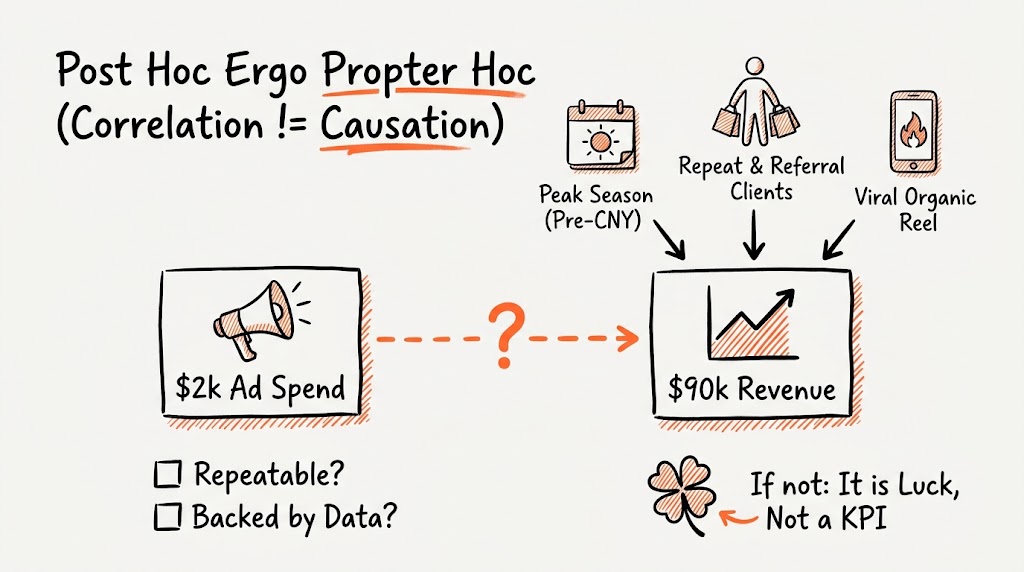
Misconception 2: The Post Hoc Fallacy (Correlation Causation)
In classical logic, Post hoc ergo propter hoc ("after this, therefore because of this") is the error of assuming that because Event B followed Event A, Event A caused Event B.
Revenue in Singapore’s domestic market does not exist in a vacuum. It is heavily dictated by macroeconomic shifts and hyper-local cultural seasonality:
- The 7th Lunar Month (Hungry Ghost Festival): Every year during the Seventh Lunar Month, superstitious homeowners across Singapore strictly avoid knocking down walls (hacking), commencing wet works, or signing renovation contracts. Aesthetic clinics experience a similar dip for invasive procedures. If your revenue drops in August, blaming your Google Ads agency is illogical—the entire domestic market is holding its breath.
- The Pre-CNY Rush vs. Post-CNY Lull: Renovation firms experience artificial revenue spikes in Q4 as homeowners rush to finish carpentry before Chinese New Year, followed by a natural structural lull in February.
- Macro Interest Rates & Regulatory Shifts: Changes in HDB rules, ABSD (Additional Buyer's Stamp Duty) hikes, or tighter MOH aesthetic advertising enforcements directly compress consumer conversion velocity, regardless of how chio your ad creatives look.
Conversely, when revenue spikes during a seasonal boom, grounded agencies do not claim 100% credit without isolating organic repeat orders and referral momentum through custom GA4 executive reporting dashboards.
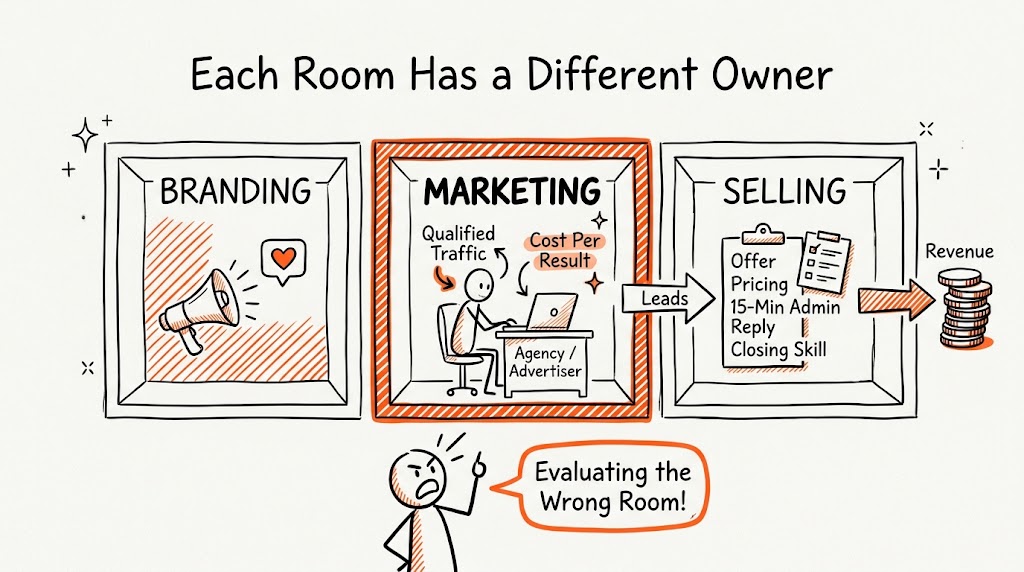
Misconception 3: Entering the Wrong Room (Branding vs. Marketing vs. Selling)
This is where the fiercest taichi (blame-shifting) occurs between clients and agencies.
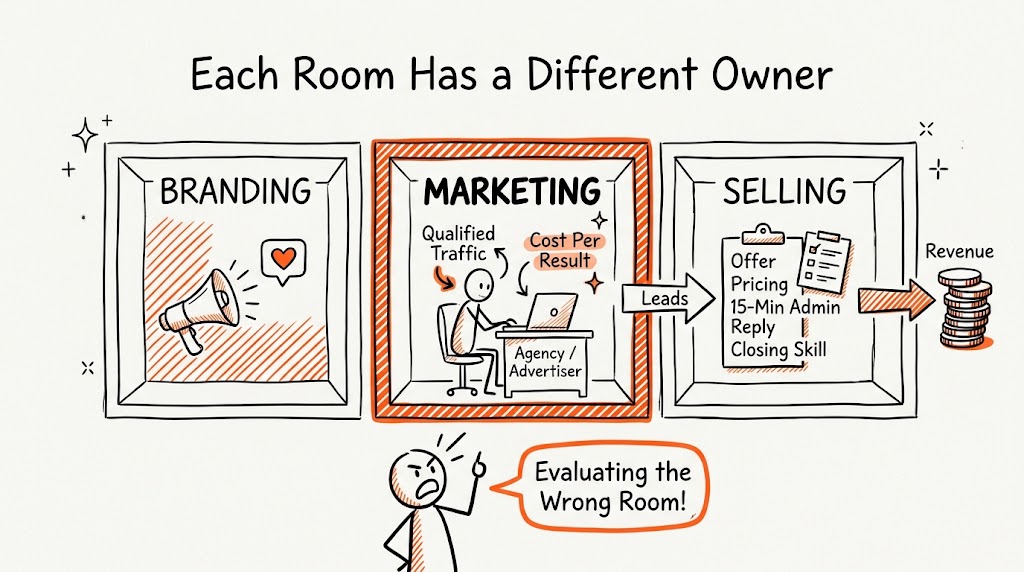
Commercial growth is housed inside three separate rooms. When revenue stalls, you must diagnose which room is actually on fire:
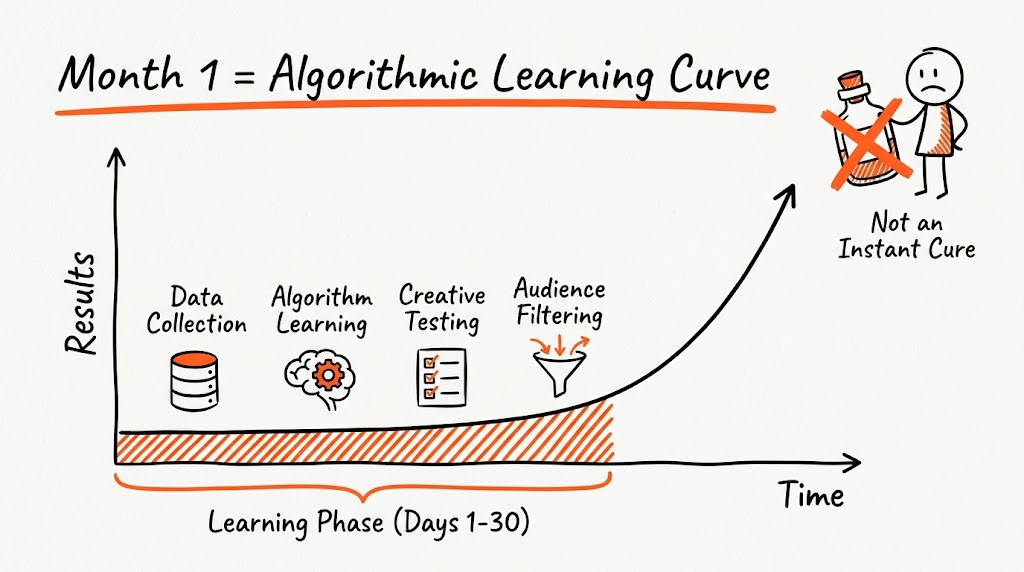 Figure 2: The 3-Room Commercial Architecture. An advertising agency controls Marketing (driving qualified traffic to the door). What happens inside the Selling room is governed by your internal team.
| Commercial Room | Core Objective | Key Metrics Tracked | Primary Owner |
|---|---|---|---|
| Room 1: BRANDING | Perception, trust, & authority | Brand search volume, AI citations, CaseTrust / MOH credibility | Joint (Founder Vision + Brand Strategy Agency) |
| Room 2: MARKETING | Capturing attention & driving qualified leads | Cost per Qualified Lead, CTR, Landing Page Conversion Rate | Your Digital Marketing Agency (24owlsgroup) |
| Room 3: SELLING | Converting inquiries into cash revenue | Speed-to-Lead (<15 mins), Show-up Rate, Quotation Closing % | Your Internal Sales / Front-Desk / ID Team |
Here is the uncomfortable truth: Your performance marketing agency lives in Room 2. They do not hold the keys to Room 3.
Suppose our high-ticket Meta Ads funnel delivers 25 pre-qualified condominium owners with verified budgets above $100,000 SGD directly into your WhatsApp inbox.
However, your senior designers are busy on-site and take 48 hours to reply. When they finally respond, they send a cold, one-line message asking for a floor plan without building rapport. Or, in an aesthetic clinic context, the front-desk receptionist replies curtly during makan time and subjects the patient to aggressive package hard-selling during the first consultation.
The prospect ghosts. Revenue is zero.
Is the advertising broken? No. Room 2 did its job flawlessly, but Room 3 burned the money to ashes.
4. The Agency Blueprint: 3 Non-Negotiable Alignment Rules Before Day One
The Modular Core:
Eliminating the Expectation Gap requires codifying three operational agreements prior to launching any campaign: establishing a realistic 30-to-90-day algorithmic calibration roadmap, validating historical baseline benchmarks against empirical data, and signing a binding RACI Matrix that separates agency traffic generation from internal sales execution.
As we advise founders in our guide on how to choose a digital marketing agency in Singapore, a mature partnership never begins with blind optimism. At 24owlsgroup, we enforce three structural alignment protocols before spending a single dollar of your media budget:
1. Lock In the 30–90 Day Calibration Timeline
We break every engagement into three transparent 30-day phases so leadership knows exactly what to expect:
- Days 1–30 (Infrastructure & Data Calibration): Deploying tracking pixels, building pre-qualification diagnostic landing pages, pruning thin GSC pages, and launching baseline creative split-tests. Goal: Signal collection and lead quality filtering—not instant 10x ROAS.
- Days 31–60 (Funnel Optimisation & Velocity): Eliminating underperforming ad sets, scaling winning architectural walkthroughs or doctor educational reels, and tightening negative keyword lists. Goal: Stabilising Cost per Qualified Showroom/Clinic Booking.
- Days 61–90 (Commercial Compounding): Sales pipeline maturation. Prospects who entered the funnel in Month One conclude their consultations, review quotations, and sign contracts. Goal: Measurable net margin ROAS and predictable scaling.
2. Validate Baseline Benchmarks (Where Did Your Numbers Come From?)
Never let a client—or an agency salesperson—pull target KPIs out of thin air. If a studio owner demands a $15 SGD Cost Per Lead for landed property renovations, we ask two questions:
- "Where did that benchmark come from?"
- "Was that data achieved consistently over six months, or was it a one-off anomaly from three years ago?"
By anchoring targets to live Singapore auction data (where high-intent interior design search clicks cost 30+ SGD and qualified condo leads require deliberate funnel friction), both parties operate in reality rather than fantasy. You can benchmark realistic campaign budgets anytime using our Singapore project estimate calculator.
3. Enforce the RACI Matrix (Who Holds What?)
To prevent wayang excuses and finger-pointing, we establish a strict RACI Matrix (Responsible, Accountable, Consulted, Informed) across the entire acquisition funnel:
| Funnel Stage & Activity | Agency (24owlsgroup) | Client (ID Firm / Clinic) | Operational SLA / Standard |
|---|---|---|---|
| Ad Creative & Copywriting | R / A | C | British English, MOH / CaseTrust compliant |
| Media Buying & Keyword Filtering | R / A | I | Daily negative keyword & budget gate enforcement |
| Landing Page & Qualification Quiz | R / A | C | Enforces >$80k budget floor (ID) or treatment intent |
| AI Search & GEO Citation Tracking | R / A | I | Monitored via AI citation tracking protocols |
| WhatsApp Speed-to-Lead Response | I | R / A | Must contact lead within < 15 minutes |
| Showroom / Clinical Consultation | I | R / A | Consultative diagnostic, zero hidden VO / hard-sell |
| CRM Disposition & Feedback Loop | C | R / A | Weekly update on lead quality & signed contract value |
(Legend: R = Responsible for execution | A = Accountable for outcome | C = Consulted | I = Informed)
When a lead enters the CRM at 2:00 PM and has not been contacted by 2:15 PM, the RACI Matrix makes accountability crystal clear.
5. Frequently Asked Questions
Why shouldn't I judge my agency's performance by first-month revenue?
In high-ticket Singapore industries like interior design (250k contracts) and medical aesthetics, the consumer decision cycle spans 4 to 8 weeks. Evaluating revenue at Day 30 measures the closing of leads generated before the agency was hired, whilst ignoring the pipeline currently incubating in your consultation calendar.
What should we measure in Month One if not immediate revenue?
Track leading indicators of commercial intent: Landing Page Qualification Rate (percentage of visitors meeting your minimum budget threshold), Cost per Qualified Appointment Booked, Search Impression Share on high-intent keywords, and Internal Speed-to-Lead.
How do we know if low sales are caused by bad leads or bad closing?
Audit the recording or transcript of the first touchpoint. If 20 prospects explicitly check the "150,000 SGD Budget" box on your landing page and upload their condominium floor plan, the lead intent is verified. If zero of those 20 prospects sign after meeting your team, the bottleneck resides in Room 3 (pricing structure, rapport, or follow-up rigor).
6. Partner With an Agency That Tells You the Truth
A world-class growth partner is not the agency that promises you 10x revenue in seven days during a flashy sales pitch. It is the agency that respects your intelligence enough to calibrate expectations, protect your ad spend from algorithmic waste, and hold both our engineers and your sales team accountable from Day One.
Explore our full suite of digital marketing services in Singapore, or book a diagnostic call below to build a transparent, high-margin acquisition engine.
NO FAIRY TALES. JUST UNIT ECONOMICS.See where your studio or clinic is leaking pipeline revenue today—benchmarked against top Singapore competitors, no pitch required.
Written by the Senior Commercial Strategists at 24owlsgroup — Building High-Trust, High-Ticket Acquisition Engines in Singapore.